
Tree services in Summerville, SC
Plan removal, tree trimming or fallen-tree cleanup using the local checks below. For service scope, start with tree removal, trimming and pruning or storm damage work.
Tree services in Summerville



South Carolina tree-work decisions
Summerville tree work involves two separate practical checks: the Town's tree-review process and the size and preparation limits for collected yard material. Establish town jurisdiction, explain the proposed operation, and decide how branches, trunk sections and stump material will leave the property before agreeing to a project.
Verify the town boundary and the actual project
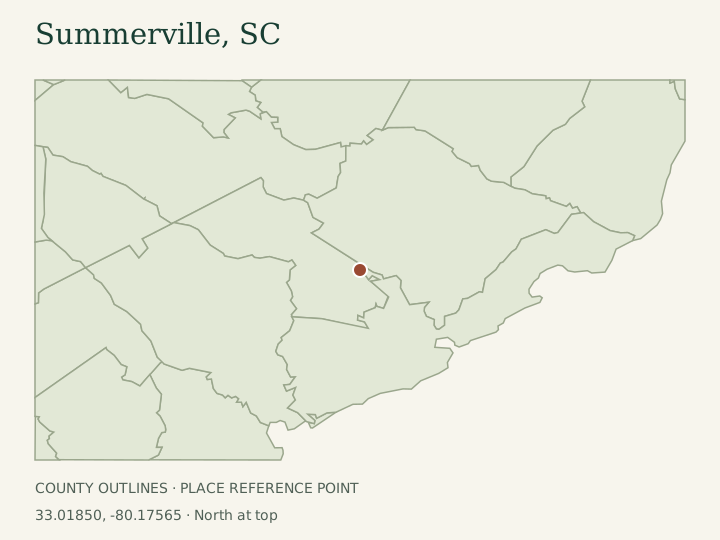
A Summerville postal address is not enough to establish that the Town's rules and collection service apply. Check the parcel and address with the Town before using its application route. The queue's Dorchester County reference point is a geographic locator, not a finding about the county of every property served by the postal name.
Describe whether the project is routine care on an existing property or part of construction. Include the proposed building, pool or access changes where applicable. The Town's current tree-review page distinguishes those situations. A review based on an existing yard should not be carried into a substantially changed construction plan without asking whether the evidence and approvals still fit.
Prepare the tree information for review
The current page describes removal review beginning at eight inches diameter at breast height, including dead trees, and Tree Protection Board review at sixteen inches or greater. Ask the Town to confirm current classification and the applicable route. Avoid scheduling cutting on the assumption that a submitted application or contractor estimate is the same as approval.
A useful request identifies the species if known, each tree's location and the reason for the proposed action. Photographs and an assessor's explanation can make a condition concern clearer. Ask what evidence would distinguish a tree needing removal from one that can be retained with appropriate pruning or another measure. The recommendation should explain the actual property conflict rather than rely on the word 'overgrown.'
Use different briefs for removal and pruning
For removal, compare the recommended operation, applicable review, equipment route, retained-tree protection and completed cleanup. For pruning, describe the branch conflict, canopy to remain and purpose of each proposed cut. Keep estimates comparable by giving bidders the same marked photographs and site constraints.
Pruning timing should follow the tree's needs and the objective. Clemson's South Carolina guidance addresses differences between plants and their growth patterns. Ask the assessor for a species-aware recommendation rather than treating an advertised annual trimming package as a requirement. Utility-line work and public-tree work need the responsible authority's direction before a private work order is appropriate.
Match cleanup to the Town's actual limits
The yard-debris page describes weekly service for town residents, accepts prepared open piles or paper bags, and limits limbs to four feet long and six inches in diameter. Large trunk sections and stumps are excluded. An ordinary collection calendar therefore cannot settle the material plan for a whole-tree removal.
Keep construction material out of vegetative piles and do not expect yard debris placed in bins or roll carts to be emptied. Confirm contractor-generated material eligibility directly; the described residential service is not proof that a hired crew may leave its complete load. Where the material does not qualify, ask the contractor for complete haul-away and an accepted receiving route.
Keep service requests and emergency work distinct
The Town request page provides street, stormwater and yard-service entry points. Use the appropriate route for a routine public problem and provide the address and location details. For immediate threats to people, contact emergency services; involved wires belong with the utility. A routine online report should not be treated as an urgent dispatch confirmation.
Consider an owner planning removal near a proposed pool: establish jurisdiction, obtain the construction-related review instructions, settle the tree decision and compare proposals that include oversized wood disposal. After a storm, revisit the actual damage and current Town announcements instead of applying an old routine scope unchanged. Neither a scheduled pickup nor a general storm page guarantees private-property clearance.
Questions about this work
Does a Summerville mailing address establish town service?
No. Confirm the parcel's jurisdiction and collection eligibility with the Town before relying on its permit or yard-debris process.
Will the yard crew collect a whole trunk or stump?
The published routine guidance excludes large trunk sections and stumps. Arrange an appropriate separate route for that material.
Can I use a removal brief for pruning bids?
A pruning brief needs its own branch objectives, retained-canopy limits, timing and cleanup. A broad removal or clearing proposal does not define those choices.
Nearby field guides
Great-circle distances between GeoNames place points, not driving distances or service coverage. Showing up to eight nearest published guides.
Preparing your local map…
The map loads automatically as you approach it. City links work without JavaScript.
Distances between GeoNames place points, not driving distances or service coverage. US Census January 2025 state/county boundaries, not municipal limits. Points: GeoNames, CC BY 4.0. Map interface: Leaflet.