
Tree services in Pooler, GA
Plan removal, tree trimming or fallen-tree cleanup using the local checks below. For service scope, start with tree removal, trimming and pruning or storm damage work.
Tree services in Pooler



Georgia tree-work decisions
In Pooler, prepare the tree decision and the debris decision together. City forms provide a tree-review route, while routine collection accepts only limited, prepared yard material. A large removal should include its own hauling plan rather than leave a trunk beside the household carts.
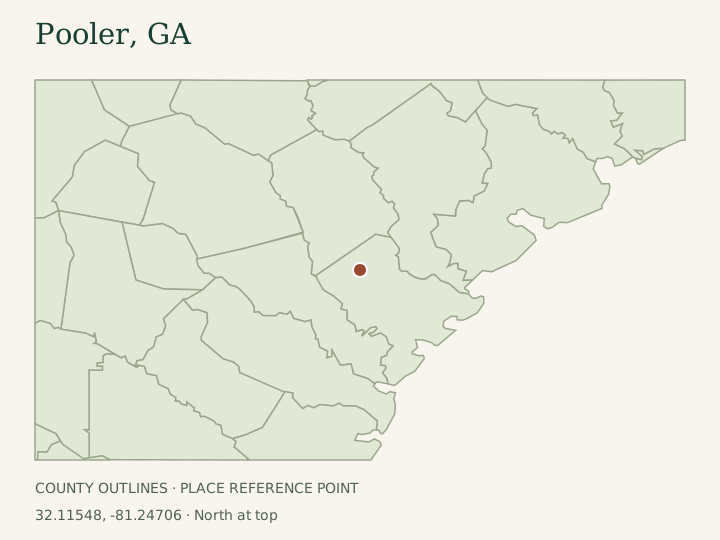
Confirm Pooler jurisdiction before using its forms
This guide concerns the City of Pooler, Georgia, in Chatham County. Check the actual parcel and city boundary before applying municipal guidance. A Pooler mailing address, a nearby contractor's service-area page or a shared waste company does not establish jurisdiction. Record the parcel identifier alongside the street address so reviewers and bidders discuss the same property.
The city applications page links tree removal separately from land-disturbance and encroachment applications. Use that distinction to explain your project accurately. Taking out a single tree, clearing for a building and staging machinery in a public area may raise different questions. Ask Planning which current approvals apply rather than choosing whichever online form appears easiest.
Describe the tree before choosing the work
The tree-removal application asks for location, size, diameter at breast height, species and proposed mitigation. Gather these details with an assessor where needed. A marked photograph helps connect the paperwork with the stem on the ground. Do not estimate a protected status from a distant canopy photograph or confuse trunk diameter with the crown's spread.
If the concern is a branch touching a roof, ask whether pruning can meet the objective. If the tree appears unstable or declining, seek a condition assessment before choosing removal. The assessment should explain what is observed and what remains uncertain. A recommendation is more useful when it names a specific operation and its expected result than when it simply describes the tree as too large.
Check restrictions without reading exemptions into a portal
Pooler's online portal labels one tree application category as commercial removal, while the city also publishes a general tree-removal form. That difference does not prove every residential operation is exempt. Give Planning the parcel, land use and intended work and request the correct route. Keep the answer with the agreed contractor scope.
For development-related work, identify trees to remain, proposed access and any landscape obligations. For routine care, ask about restrictions affecting a retained tree or public frontage. Association approval and city permission answer separate questions. Do not assume an association's consent authorizes work on a public tree or satisfies municipal conditions on an approved landscape plan.
Design cleanup around the current limits
The current waste page limits routine collection to ten brown-paper bags, no more than forty-five pounds each, and a neatly stacked four-foot cube of limbs. Wood exceeding four inches in diameter is outside that described route. Confirm service eligibility and the precise load with the collector before treating it as a project inclusion.
An entire removed tree may produce trunks, chips and stump material that cannot be prepared within those limits. Ask for contractor haul-away and an accepted receiving destination when needed. Do not put yard material into garbage or recycling to avoid the limits. The estimate should say whether chipping, loading, transport and disposal are included, and who handles a rejected load.
Keep storm instructions tied to their event
Pooler's Helene updates concern September 2024 and describe event-specific arrangements. An old drop-off location or emergency pickup instruction should not replace the current routine waste page. Following a new storm, check the city's current announcement and ask whether any temporary program is active for the address and material.
For example, a household planning elective removal can obtain an assessment, resolve city review and compare two complete haul-away proposals without relying on a past storm program. Include gate access, surface protection, stump choices and the desired finish. If the tree later sustains urgent damage, separate immediate safety work from the remaining elective scope and keep both approvals clear.
Questions about this work
Does the portal's commercial label exempt my house?
It is an application label, not a complete residential exemption rule. Ask Planning to apply the current requirements to the parcel and operation.
Can large trunk sections join routine yard collection?
Pooler's published routine limits exclude wood exceeding four inches in diameter. Arrange a suitable separate route for oversized material.
Is the Helene drop-off still an everyday option?
The notice describes a 2024 event. Obtain current instructions before using any temporary site or collection arrangement.
Nearby field guides
Great-circle distances between GeoNames place points, not driving distances or service coverage. Showing up to eight nearest published guides.
Preparing your local map…
The map loads automatically as you approach it. City links work without JavaScript.
Distances between GeoNames place points, not driving distances or service coverage. US Census January 2025 state/county boundaries, not municipal limits. Points: GeoNames, CC BY 4.0. Map interface: Leaflet.