
Tree services in Mount Pleasant, SC
Plan removal, tree trimming or fallen-tree cleanup using the local checks below. For service scope, start with tree removal, trimming and pruning or storm damage work.
Tree services in Mount Pleasant



South Carolina tree-work decisions
In Mount Pleasant, choose the tree-review route according to whether removal accompanies construction, then establish tree protection, replacement and disposal responsibilities. The Town separates those application paths. Its current trash page also excludes contractor-generated landscaping debris, so household pickup is not a complete contractor cleanup plan.
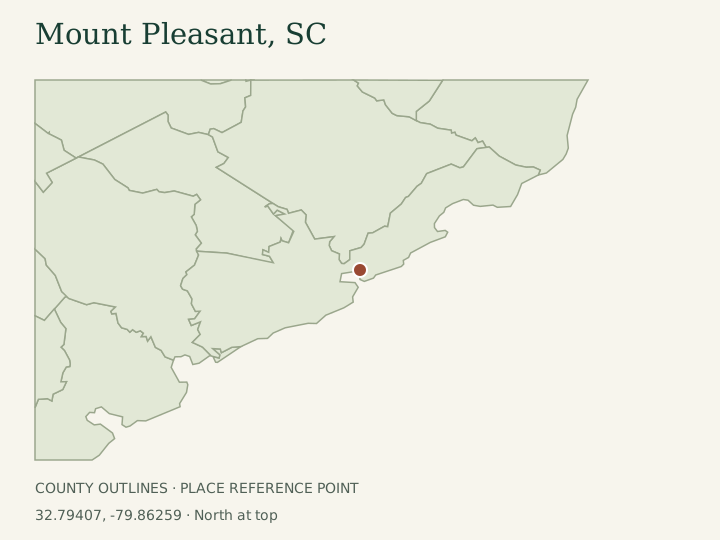
Confirm the Town and the property's purpose
This guide covers the Town of Mount Pleasant, South Carolina. Check the parcel's jurisdiction rather than relying on the postal city or a Charleston-area service listing. Provide the existing land use, intended project and tree locations when asking for instructions. A nearby city's permit or diameter rule does not establish the process here.
The Town's current applications page sends residential construction-related removal through building-permit review and keeps standalone removal on the tree-removal application route. Include pools, additions and accessory structures in the description where relevant. A homeowner should not submit a standalone tree request while omitting the construction that drives the work. Ask which current application fits the complete project.
Identify protection and the evidence needed
The tree-protection page describes residential protection at sixteen inches DBH, separate pine provisions and location-based protections. Species exceptions do not automatically apply in buffers, easements or rights-of-way. Ask Planning to confirm the classification and supporting evidence for the actual tree instead of using a single size shortcut.
Historic-tree requests require arborist evidence under the Town's published procedure. Explain the reason for removal and ask whether retention or targeted pruning could achieve the objective. Where structural damage is alleged, ask what additional documentation the reviewer needs. Keep the report, application and contractor scope tied to the same identified tree so an estimate cannot quietly expand to adjacent stems.
Resolve replacement and permission before cutting
The Town's tree page explains that mitigation may be required and recorded on the determination and permit. Ask about those obligations before accepting a cutting-only price. Replacement work and any permitted alternative arrangement need a responsible party and a clear completion plan; removing the tree does not necessarily finish the owner's project.
Confirm that the application is actually approved and the permit issued, including the Town's contractor business-license check and display instructions. A submitted form or favorable assessor's opinion is not the same as the completed permission. If the footprint, selected trees or method changes, obtain advice on whether the current approval still covers the revised work.
Keep pruning objectives narrower than a view request
For pruning, describe the branch conflict, desired clearance and canopy to retain. Mount Pleasant's tree page warns against topping and over-pruning. A more open view is not automatically a suitable instruction to remove substantial live growth, particularly where buffers or a vision corridor may be involved.
Ask the assessor for species-aware timing and a plan proportional to the objective. For a public tree or utility conflict, obtain the responsible authority's direction before arranging private work. Keep a pruning request separate from removal and from a buffer-clearing project. Each can produce a different next step even when a contractor advertises all three under one general tree-service heading.
Put the full debris result in the estimate
The current trash page limits eligible routine limbs to four feet long and eight inches diameter, excludes stumps, and excludes contractor-generated landscaping material. Its curbside collection page describes the weekly household service; that schedule does not override the contractor exclusion. Require accepted private hauling for the contracted load.
For example, an owner removing a protected tree for a pool should coordinate the building review, settle replacement conditions and compare estimates including branch and trunk disposal. A separate stump decision should cover grindings and the intended surface. Confirm the receiving route with the operator rather than assuming a resident convenience-center option admits a commercial vehicle. Keep routine clippings, contracted wood and any construction waste distinct.
Questions about this work
Does every removal use the standalone tree form?
No. The Town directs residential construction-related requests through building-permit review. Ask which route fits the complete project.
Can a contractor leave small branches for Town pickup?
The current trash page excludes contractor-generated landscaping material. Meeting residential size limits does not remove that exclusion.
Is replacement planting always included in the cutting price?
Only if the agreement says so. Resolve the Town's actual mitigation conditions and assign their completion before accepting a proposal.
Nearby field guides
Great-circle distances between GeoNames place points, not driving distances or service coverage. Showing up to eight nearest published guides.
Preparing your local map…
The map loads automatically as you approach it. City links work without JavaScript.
Distances between GeoNames place points, not driving distances or service coverage. US Census January 2025 state/county boundaries, not municipal limits. Points: GeoNames, CC BY 4.0. Map interface: Leaflet.