
Tree services in North Charleston, SC
Plan removal, tree trimming or fallen-tree cleanup using the local checks below. For service scope, start with tree removal, trimming and pruning or storm damage work.
Tree services in North Charleston



South Carolina tree-work decisions
In North Charleston, the tree-removal contractor applies for the permit when hired to do the work, and contractor-generated debris is excluded from city collection. Use those two responsibilities to structure the project: one identified applicant, a tree-specific scope, and an agreed haul-away result.
Check North Charleston jurisdiction first
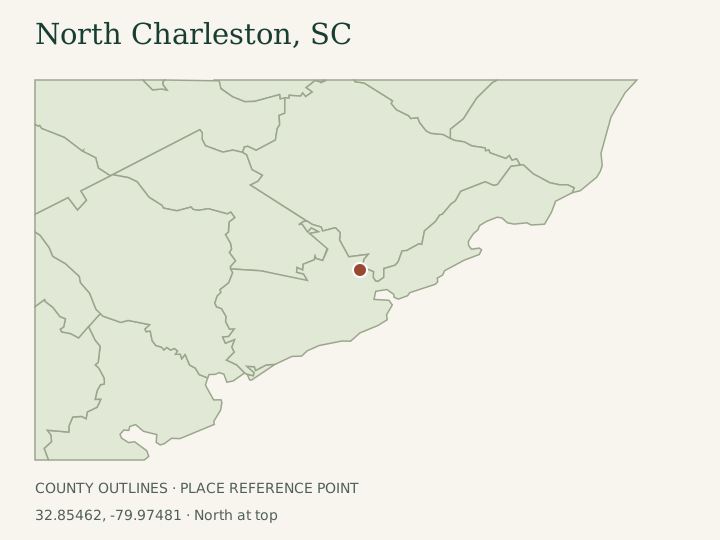
This guide addresses the City of North Charleston, South Carolina. Do not substitute City of Charleston or unincorporated county requirements because a contractor serves the wider metro. Confirm the parcel and applicable municipal authority. The GeoNames county label attached to the city reference point does not establish the county or service arrangement for every address using the name.
Begin with the city's current tree-removal page. Its process assigns the application to the hired contractor; an owner applies when doing the removal personally. Decide who will manage the submission and retain a copy of the complete scope. This is an administrative distinction, not a recommendation for an owner to undertake hazardous tree cutting.
Mark the tree and document the proposed work
The city's permit instructions call for identifying the tree for inspection, including with ribbon, and supplying a detailed proposal or contract. Plan any marking only where it can be done safely. An inspector or Urban Forester reviews the tree before the decision; make sure the written project and the tree on the ground correspond.
Ask an assessor whether the concern warrants removal, targeted pruning or further investigation. A building conflict and a condition defect need different explanations. Where several trees are present, number them and identify which remain. If an association or architectural body applies to the property, the city's instructions also call for its approval documentation where applicable; that approval does not replace the city's decision.
Choose a service with a measurable finish
For removal, define the trees, access method, protection, wood handling and stump result. For pruning, specify the branch objective and retained canopy. For storm work, identify the immediate hazard separately from later assessment and cleanup. These divisions help avoid an estimate in which 'tree service' could mean several materially different jobs.
Ask bidders to price the same outcome and describe exclusions. A proposal that leaves logs, one that chips branches on site and one that hauls all material away are not automatically equivalent. Do not infer an on-site estimate from a national cost calculator or a provider's generic city page. The actual tree, access and inclusions remain unresolved until they are assessed.
Keep contractor material out of the city pickup assumption
The current residential trash page excludes debris generated by contractors and landscapers. Its ordinary yard limits of four-foot lengths and six-inch diameter do not create an exception for a contracted job. A crew cutting wood into smaller pieces has not thereby made it eligible for household pickup.
Require the contractor to name a suitable receiving route and include transportation and disposal. If you deliberately retain chips or wood, define the quantity and location. The city's permit page also places project debris responsibility on the permittee. Align the permit scope with the cleanup agreement so there is no gap between the party managing the work and the party expected to finish it.
Use residential service rules only within their scope
Sanitation describes service-area and public-request information and requires paper bags for collected yard waste. The residential trash page requires category separation and excludes large stumps and logs. These are useful instructions for eligible household material, not a replacement for the hired crew's disposal obligation.
For example, an owner considering a rear-yard removal can first obtain the tree assessment, have the contractor prepare the identified permit scope, resolve access and compare complete haul-away bids. A separate pile of the owner's routine clippings should remain separate from that contract. Ask Sanitation about any eligibility uncertainty before putting material out; a scheduled collection day alone does not establish acceptance.
Questions about this work
Who applies when I hire a removal contractor?
The city's current instructions assign the application to the hired contractor. Agree who handles supporting documents and keeps the approval record.
Will small contractor-cut pieces qualify for city pickup?
The published exclusion concerns the material's origin as well as its size. Require contractor disposal rather than relying on household collection.
Is Charleston's permit process interchangeable?
No. Confirm the property's actual authority and use North Charleston's current process for a North Charleston parcel.
Nearby field guides
Great-circle distances between GeoNames place points, not driving distances or service coverage. Showing up to eight nearest published guides.
Preparing your local map…
The map loads automatically as you approach it. City links work without JavaScript.
Distances between GeoNames place points, not driving distances or service coverage. US Census January 2025 state/county boundaries, not municipal limits. Points: GeoNames, CC BY 4.0. Map interface: Leaflet.