
Tree services in Walhalla, SC
Plan removal, tree trimming or fallen-tree cleanup using the local checks below. For service scope, start with tree removal, trimming and pruning or storm damage work.
Tree services in Walhalla



South Carolina local tree-work decisions
In Walhalla, start by identifying the tree’s owner and the local decision you need: assessment, pruning, removal or disposal. Walhalla Planning administers the City zoning ordinance and asks owners to contact it before changes of land use, construction or subdivision.
Establish the local authority and project conditions
Walhalla Planning administers the City zoning ordinance and asks owners to contact it before changes of land use, construction or subdivision. For tree work connected to one of those projects, disclose the whole proposal and any landscape conditions before agreeing to cutting. That list is not a complete private-tree exemption or a universal removal-permit statement. Public ownership also requires separate authorization. Older council packets containing tree proposals are not treated here as proof of the current adopted tree rule. Ask Planning which current provision applies to the identified tree, site and intended work. See the source instructions for the stated scope.
Separate private care from public-tree work
Walhalla’s current Public Works page separates Sanitation from Streets & Facilities. Brush disposal is a Sanitation service; maintenance of City-owned buildings and grounds belongs to Streets & Facilities. A question about a City-ground tree should therefore identify the actual site and responsible department before it becomes a private pruning purchase. Report a non-emergency location through the City route, while keeping urgent hazards out of a routine web-form queue. These department descriptions do not give a property owner permission to alter public vegetation or promise maintenance of a privately owned tree. See the source instructions for the stated scope.
Choose an eligible destination before leaving wood
Walhalla’s knuckleboom instructions exclude roadside debris left by paid landscaping or construction contractors and assign transport to the responsible owner, tenant or contractor. The sheet also mentions a charge if the City has to remove contractor debris; treat that as an enforcement consequence, not a service available to book. Its residential size instructions do not override the paid-work exclusion. The posted solid-waste code separately excludes tree and brush material from land clearing. Classify the job before comparing a clean-yard quote with one that leaves wood at the road. See the source instructions for the stated scope.
Keep routine arrangements distinct from storm response
For a non-emergency problem on Walhalla City property, use the City reporting route and identify whether Streets & Facilities or Sanitation needs to act. A roadside tree hazard, a power outage and private damaged wood are separate reports. Verify the electric supplier from the actual account; the City’s public-works role does not establish that it is the electric operator. Immediate threats require emergency services and the serving utility, with people kept away from lines and anything they contact. Do not infer a current storm-debris entitlement from an older event or from the ordinary brush service listing. See the source instructions for the stated scope.
Confirm the receiving route for the actual load
Oconee County lists yard debris and land-clearing debris at Seneca C&D Landfill, 15031 Wells Highway. Confirm the actual truck, commercial status and stump conditions with the receiving operator before dispatch. The County distinguishes its household/recycling centers from the landfill. A place that accepts cardboard or household rubbish is not thereby the destination for a contractor’s tree load. Put transport, receiving charges and any rejected material into the estimate, with vegetation separated from demolition debris as required by the operator. See the receiving operator’s instructions.
Choose the purchase that answers the concern
Give the assessor a question before giving a crew a cutting instruction. A tree that interferes with roof clearance may need a different intervention from a declining tree beside an occupied space. Ask what can remain and why. Then distinguish the recommended tree work from transport of material already on the ground. Write down the tree labels, the desired finish and any unresolved public boundary. Send the same brief to each bidder so the comparison reflects the same outcome.
Make access and cleanup part of the agreement
Walk the proposed equipment route with the bidder and identify gates, paving, retained roots and any neighboring land. Obtain access consent where needed. Agree what happens to chips, logs, stump and disturbed ground instead of assuming that a clean yard follows from the word removal. Check insurance evidence and qualifications appropriate to the task directly. Keep the accepted scope, authority response and receiving confirmation together; a later change should identify both the extra work and its agreed cost.
A Walhalla work-brief example
Use this as a planning example, not a report of a completed job. An owner has a privately hired landscape crew and a concern about a tree on adjoining City grounds. Route the public-tree question to the City first. Specify private pruning and transport separately. The fact that Walhalla operates a brush truck does not make the paid crew’s roadside pile eligible.
Choose the guide for the property’s municipality
Walhalla and Seneca share an Oconee County receiving lead but have separate municipal collection instructions. Check the property’s own city; a common landfill does not create a common brush allowance or electric reporting route. Continue with the Seneca tree-work overview when that is the correct jurisdiction.
Before accepting the scope
- Authority: Walhalla Planning, Codes and Zoning, Sanitation and Streets & Facilities: identify the tree, project and applicable decision.
- Scope: List assessment, pruning or removal separately from hauling and ground work.
- Access: Agree protection for surfaces, retained roots and shared routes.
- Material: Confirm the actual receiver, load category, transporter and collection date.
Questions about this work
Who should decide the local conditions for Walhalla tree work?
Walhalla Planning administers the City zoning ordinance and asks owners to contact it before changes of land use, construction or subdivision. Keep the exact location, ownership and proposed task with the inquiry; a contractor quote does not settle an authority decision.
Will Walhalla collect the branches left by my hired crew?
Walhalla’s knuckleboom instructions exclude roadside debris left by paid landscaping or construction contractors and assign transport to the responsible owner, tenant or contractor. Apply the stated generator and material category to the actual job. Confirm any exception or unspecified load with the operator before relying on public pickup.
Which receiving question belongs in my Walhalla work brief?
Oconee County lists yard debris and land-clearing debris at Seneca C&D Landfill, 15031 Wells Highway. Confirm the actual truck and material, then name who will transport excluded or rejected wood.
Sources and scope
Checked: November 4, 2026. City instructions retain their municipal, development or collection scope. Clemson University Extension is a separate technical source. Applicability qualifications, dated storm notices and receiving conflicts are identified above. Regional tree-care guidance, utility work and receiving instructions retain their own scopes. Individual parcel permission, load admission and provider coverage still need project-specific confirmation. Dated documents are identified in the text; confirm current requirements for the actual property and load. Work-brief examples are hypothetical planning aids. No site inspection, individual contractor verification or receiver admission has been completed for your project.
Nearby field guides
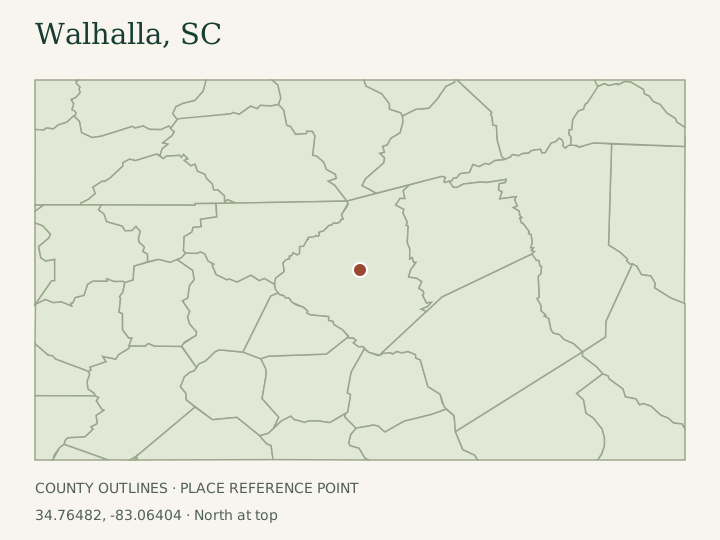
Great-circle distances between GeoNames place points, not driving distances or service coverage. Showing up to eight nearest published guides.
Preparing your local map…
The map loads automatically as you approach it. City links work without JavaScript.
Distances between GeoNames place points, not driving distances or service coverage. US Census January 2025 state/county boundaries, not municipal limits. Points: GeoNames, CC BY 4.0. Map interface: Leaflet.