
Tree services in Clemson, SC
Plan removal, tree trimming or fallen-tree cleanup using the local checks below. For service scope, start with tree removal, trimming and pruning or storm damage work.
Tree services in Clemson



South Carolina local tree-work decisions
In Clemson, start by identifying the tree’s owner and the local decision you need: assessment, pruning, removal or disposal. Clemson’s section 15-30.15 addresses canopy protection in development, identifies Protected Trees through required tree and landscaping standards, and contains exemptions.
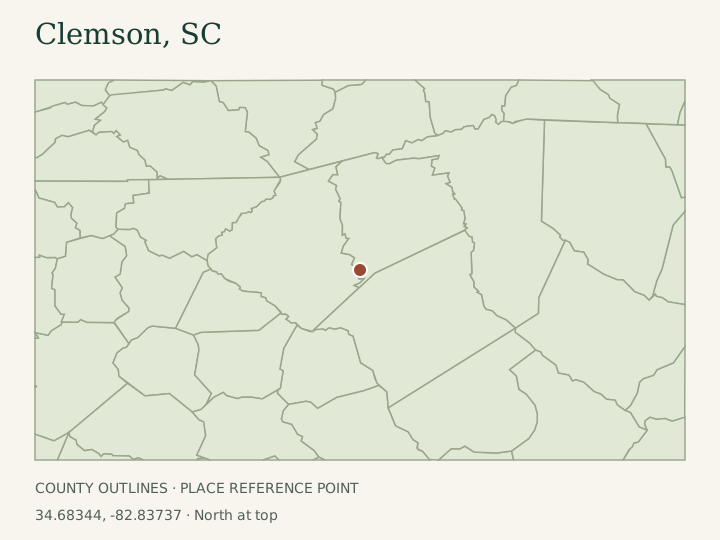
Establish the local authority and project conditions
Clemson’s section 15-30.15 addresses canopy protection in development, identifies Protected Trees through required tree and landscaping standards, and contains exemptions. The owner’s removal or trimming of a non-Protected Tree on a single-family lot is listed as exempt from this section; that wording is not a blanket exemption for every residential tree or every other rule. Ask Planning and Codes to identify the applicable status before committing to work. For covered Protected Tree removal, the section provides a permit process and written conditions. A tree survey is described, with application requirements modifiable for the actual project. Keep the City’s determination with the estimate rather than having bidders guess whether the planting was required. See the source instructions for the stated scope.
Separate private care from public-tree work
Clemson’s Trees page describes its Public Tree Ordinance and says the City uses ANSI A300 pruning standards. Urban and Park Land Management identifies public-land tree care and its public-tree ordinance among its responsibilities. If a canopy adjoins a street, park or public planting area, establish who controls the tree before commissioning a private crew. The City’s stated standard does not certify a contractor, provide access permission or prescribe a pruning quantity for your tree. Tell the assessor whether the desired outcome is pedestrian clearance, roof clearance, removal of damaged limbs or long-term structure, and identify trees that must remain untouched. See the source instructions for the stated scope.
Choose an eligible destination before leaving wood
Clemson’s Street Maintenance page separates resident brush arrangements from contractor-generated limbs, which the City excludes from curbside pickup. It lists the grinding site beside Public Works at 1155 Old Central Road as a receiving option, including a separate contractor limb arrangement. Confirm the current fee and permitted load before booking transport; neither the curb rule nor the receiving description establishes acceptance of a root ball, oversize trunk or mixed construction waste. The same City page gives different closing times and a lunch closure. Check the actual gate schedule rather than selecting the later time. Put the accepted receiver and any rejected material in the written hauling scope. See the source instructions for the stated scope.
Keep routine arrangements distinct from storm response
Clemson’s Weather Wise page points readers to City alerts and MyCivic issue reporting, and lists both Duke Power and Blue Ridge Electric outage contacts. Identify the serving operator from the actual account instead of assuming one company serves every address. Ordinary issue reporting is separate from emergency response: immediate danger or a downed line requires emergency and utility reporting, with people kept away. A report about a blocked public route does not establish that private tree work or hauling has been purchased. Record the work that responders complete and arrange assessment of remaining attached damage before accepting a detached-debris cleanup quote. See the source instructions for the stated scope.
Check whether a disaster waiver actually applies
Section 15-30.15 lists disaster cleanup mitigation among its exemptions and describes a typically City-issued period of relaxed application. Obtain the current City determination and its dates for your project. A past storm, a damaged appearance or an old announcement cannot establish a waiver today. Have the assessor document the reason for the proposed work and keep the authority response with later planned restoration. See the canopy protection section.
Separate clean vegetation from mixed debris
South Carolina DES distinguishes facilities by the material they can receive and advises checking opening and acceptance before a delivery, particularly after storms. Keep wood separate from demolition material in the proposed hauling scope. Ask the hauler to name an alternative approved receiver for any material the City grinding site will not take. A waste-category description is not confirmation that a particular truck can unload there. See DES storm-debris facility guidance.
Choose assessment, authorized cutting or material transport
Start with the unresolved decision. A living tree with an uncertain condition needs an assessment request; an approved removal needs a defined cutting and cleanup scope; a safely detached pile may need a hauling purchase. Tell each bidder which of those tasks has already been completed. Provide a simple tree list, safe photographs, access constraints and the desired ground finish. Request evidence of insurance directly and verify qualifications appropriate to the work. Keep assessment conclusions separate from the City’s determination, because a recommendation to remove and authority to remove answer different questions.
Write the finish before comparing totals
A useful estimate says whether the tree remains, which canopy objective applies, or which marked tree is removed. It also identifies branch transport, trunk sections, stump treatment, grindings and surface repair individually. If equipment must cross paving or travel near retained planting, ask the bidder to describe its route and protection measures. Establish access consent before relying on a neighbor’s driveway. Compare the same finish across bidders and record how additional work is approved. The site’s quote-comparison guide expands the general purchasing checklist; Clemson’s specific authority and material decisions remain the starting point here.
A Clemson work-brief example
Use this as a planning example, not a report of a completed job. Suppose a property has one tree beside a sidewalk, another in an approved landscape strip and a rear-yard pile of branches. Do not send a single instruction to “clear everything.” Ask the City about the first two trees, mark retained planting on the brief, and state whether the pile was generated by a paid crew. Obtain separate assessment and hauling scopes if those decisions are still unresolved. A resident collection expectation can fail as soon as the material category is wrong.
Use the guide for the property’s actual jurisdiction
A Greenville property follows a different Tree Disturbance review and City Solid Waste customer process from Clemson’s canopy rules and grinding-site arrangement. For a job within Greenville rather than Clemson, continue with Greenville tree-work overview. Each municipality decides its own requirements and collection eligibility; these links do not imply shared rules or provider coverage.
Before accepting the scope
- Authority: City of Clemson Planning and Codes / Urban and Park Land Management: identify the tree, project and applicable decision.
- Scope: List assessment, pruning or removal separately from hauling and ground work.
- Access: Agree protection for surfaces, retained roots and shared routes.
- Material: Confirm the actual receiver, load category, transporter and collection date.
Questions about this work
Which local question should I resolve first?
Identify the property and the tree’s public or private status, then ask City of Clemson Planning and Codes / Urban and Park Land Management about the relevant local process. Owner permission, a professional recommendation and an authority decision are separate.
Can I leave all removal material for routine collection?
Use the specific local material category and account eligibility. Clemson’s Street Maintenance page separates resident brush arrangements from contractor-generated limbs, which the City excludes from curbside pickup. Ask the operator about large wood, stumps, contractor loads and the intended date before accepting an estimate that leaves them.
How do I compare companies without a local price claim?
Give bidders the same tree labels, authority information, access constraints and desired finish. Request itemized written scopes and verify insurance and required qualifications directly. The comparison should resolve differences in work and cleanup before comparing totals.
Sources and scope
Checked: November 3, 2026. City instructions retain their municipal, development or collection scope. Clemson University Extension is a separate technical source. The Street Maintenance page has conflicting closing times; confirm the actual receiving schedule. Regional tree-care guidance, utility work and receiving instructions retain their own scopes. Individual parcel permission, load admission and provider coverage still need project-specific confirmation. Dated documents are identified in the text; confirm current requirements for the actual property and load. Work-brief examples are hypothetical planning aids. No site inspection, individual contractor verification or receiver admission has been completed for your project.
- Clemson Code: Section 15-30.15 Canopy Protection and Replacement
- Clemson: Trees and Public Tree Ordinance
- Clemson: Urban and Park Land Management
- Clemson: Street Maintenance and Brush Collection
- Clemson: Weather Wise
- Clemson University Extension HGIC 1003: Principles and Practices for Pruning Trees (2019)
- Duke Energy: Look Up and Live / downed lines
- South Carolina DES: Debris Management in South Carolina
Nearby field guides
Great-circle distances between GeoNames place points, not driving distances or service coverage. Showing up to eight nearest published guides.
Preparing your local map…
The map loads automatically as you approach it. City links work without JavaScript.
Distances between GeoNames place points, not driving distances or service coverage. US Census January 2025 state/county boundaries, not municipal limits. Points: GeoNames, CC BY 4.0. Map interface: Leaflet.