
Tree services in Seneca, SC
Plan removal, tree trimming or fallen-tree cleanup using the local checks below. For service scope, start with tree removal, trimming and pruning or storm damage work.
Tree services in Seneca



South Carolina local tree-work decisions
In Seneca, start by identifying the tree’s owner and the local decision you need: assessment, pruning, removal or disposal. Seneca Planning & Development publishes the zoning ordinance, City-limits information and a CitizenServe application route.
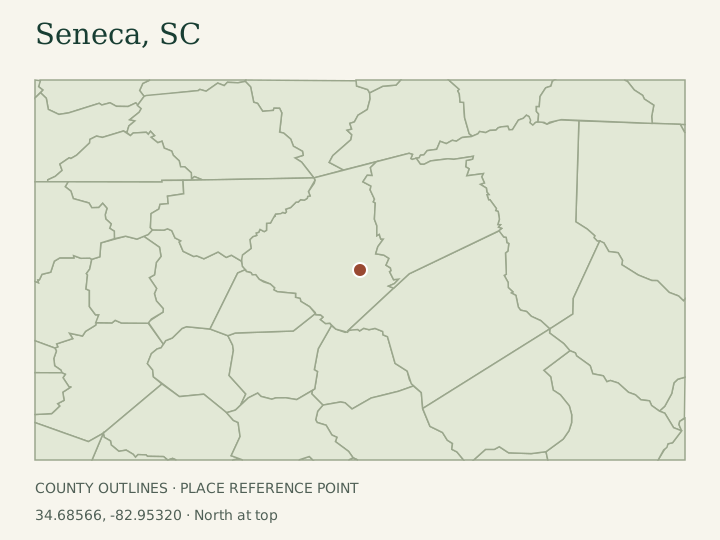
Establish the local authority and project conditions
Seneca Planning & Development publishes the zoning ordinance, City-limits information and a CitizenServe application route. Its page tells users to confirm current official records with staff before relying on online planning data. Identify the actual parcel and project, including any approved landscape plan or design-review condition, when asking what review applies. The linked ordinance contains use-specific landscape obligations: its self-storage provisions, for example, require a development landscape plan and maintained planting. That example does not impose a universal residential tree-removal permit or prove an ordinary backyard tree exempt. Resolve the actual condition with Planning before scheduling elective cutting; this guide does not establish a citywide private-tree diameter threshold. Read the use-specific ordinance provisions. See the source instructions for the stated scope.
Separate private care from public-tree work
Seneca’s Street Department lists trimming and maintaining City rights-of-way and removing unsafe right-of-way trees among its duties. It also works with SCDOT and Oconee County on streets and rights-of-way. A branch over a road therefore needs an ownership and road-authority check before being added to a private pruning order. Ask Public Works to identify the responsible route for that location. Its maintenance list is not a promise to prune every privately owned canopy near a street. For a private tree, describe the actual clearance or structural concern and have the assessor specify the retained canopy and access needed. See the source instructions for the stated scope.
Choose an eligible destination before leaving wood
Seneca’s detailed Curbside Waste Collection page requires commercial contractors to dispose properly of the yard waste they generate. Resident placement limits do not convert that paid load into City pickup. For eligible residential properties with three or fewer dwellings, the page limits yard waste to three cubic yards cumulatively and limbs to six inches diameter and six feet long. Similar materials must be separated, with one distinct pile per category; placement also needs five-foot separation and twenty-foot overhead clearance. These are collection conditions, not instructions to move hazardous wood. An older Residential Garbage page still mentions brush/C&D service, but the detailed current policy expressly excludes curbside construction and demolition debris. Use the detailed policy and confirm disputed loads with Sanitation. Compare the older residential overview with the detailed policy. See the source instructions for the stated scope.
Keep routine arrangements distinct from storm response
Seneca Light & Water’s Electricity page identifies a City-owned distribution utility and describes its service area as property within City limits; it separately names Duke Energy and Blue Ridge Electric Cooperative as County suppliers. Establish the actual operator from the property account rather than sending every Seneca postal address to Duke. The same page includes an older wholesale-contract period ending June 2025, so that historical contract text is not used as evidence of a present supply agreement. An outage report, a public road obstruction and private damaged-tree assessment are separate tasks. Immediate danger needs emergency reporting and the serving utility, with people kept clear of lines and contacting trees. Once responders release the scene, identify attached hazards before arranging detached-wood hauling. See the source instructions for the stated scope.
Confirm the receiving route for the actual load
Oconee County lists yard debris and land-clearing debris among accepted categories at the Seneca C&D Landfill, 15031 Wells Highway. The County identifies its recycling centers separately as household-trash and recycling sites; do not substitute one for the landfill. Published landfill hours are Monday–Saturday, 7:15 a.m.–3:45 p.m., with entry before 3:30 p.m. Confirm holiday changes, the truck’s origin and commercial status, current charges, and any stump, root-ball or size conditions before dispatch. Category acceptance is a receiving lead, not admission approval for a particular load. Name the accepted destination and a fallback for rejected material in the hauling agreement. See the receiving operator’s instructions.
Build a brief that separates the three purchases
An assessment answers what intervention is justified. Cutting or pruning performs an agreed intervention. Transport resolves the resulting material. In Seneca, the last purchase becomes especially important when a commercial crew generates the waste. Give bidders tree labels, the unresolved condition question, known public boundaries and the desired cleanup result. If one estimate only cuts and another leaves a finished yard, ask for matching scope before comparing their totals. Obtain insurance evidence directly and check qualifications relevant to the proposed work. A listing in search results is not a credential check.
Record access and the ground finish
Show bidders the proposed equipment route and identify paving, retained roots, gates and neighboring property. Obtain necessary access consent before treating a shared driveway as available. List the stump, grindings and restoration separately; a quote saying “tree removal” leaves those outcomes uncertain. Record who approves additional work and how changes will be documented. Keep the City response and any receiving confirmation with the accepted estimate so a later crew does not have to reconstruct the plan.
A Seneca work-brief example
Use this as a planning example, not a report of a completed job. Suppose a homeowner wants a roadside tree assessed and a contractor’s rear-yard branch pile removed. First ask Public Works which authority controls the roadside location; then ask the assessor whether the tree should remain. Keep the existing branch pile in a separate hauling line. The crew-generated pile does not qualify for City pickup merely because the address is residential. Require the hauler to confirm its destination before leaving the material at the curb.
Choose the guide for the property’s municipality
Seneca and neighboring Clemson have separate municipal procedures. A Seneca postal address does not establish City limits, and Clemson’s protected-tree or grinding-site arrangements do not decide a Seneca project. For a property actually in Clemson, use its guide to check that City’s own authority and material route. Continue with the Clemson tree-work overview when that is the correct jurisdiction.
Before accepting the scope
- Authority: Seneca Planning & Development, Public Works and Seneca Light & Water: identify the tree, project and applicable decision.
- Scope: List assessment, pruning or removal separately from hauling and ground work.
- Access: Agree protection for surfaces, retained roots and shared routes.
- Material: Confirm the actual receiver, load category, transporter and collection date.
Questions about this work
Which local question should I resolve first?
Identify the property and the tree’s public or private status, then ask Seneca Planning & Development, Public Works and Seneca Light & Water about the relevant local process. Owner permission, a professional recommendation and an authority decision are separate.
Can I leave all removal material for routine collection?
Use the specific local material category and account eligibility. Seneca’s detailed Curbside Waste Collection page requires commercial contractors to dispose properly of the yard waste they generate. Ask the operator about large wood, stumps, contractor loads and the intended date before accepting an estimate that leaves them.
How do I compare companies without a local price claim?
Give bidders the same tree labels, authority information, access constraints and desired finish. Request itemized written scopes and verify insurance and required qualifications directly. The comparison should resolve differences in work and cleanup before comparing totals.
Sources and scope
Checked: November 4, 2026. City instructions retain their municipal, development or collection scope. Clemson University Extension is a separate regional technical source. Applicability qualifications, dated storm notices and receiving conflicts are identified above. Regional tree-care guidance, utility work and receiving instructions retain their own scopes. Individual parcel permission, load admission and provider coverage still need project-specific confirmation. Dated documents are identified in the text; confirm current requirements for the actual property and load. Work-brief examples are hypothetical planning aids. No site inspection, individual contractor verification or receiver admission has been completed for your project.
- Planning & Development – City of Seneca
- Seneca zoning ordinance — use-specific landscaping provisions
- Street Department – City of Seneca
- Curbside Waste Collection – City of Seneca
- Oconee County South Carolina Solid Waste Recycling Centers & Landfills
- Electricity – City of Seneca
- Clemson Extension: Principles & Practices for Pruning Trees (HGIC 1003, revised 2019)
- Duke Energy: Look up and live — electrical safety
Nearby field guides
Great-circle distances between GeoNames place points, not driving distances or service coverage. Showing up to eight nearest published guides.
Preparing your local map…
The map loads automatically as you approach it. City links work without JavaScript.
Distances between GeoNames place points, not driving distances or service coverage. US Census January 2025 state/county boundaries, not municipal limits. Points: GeoNames, CC BY 4.0. Map interface: Leaflet.