
Tree services in Johns Creek, GA
Plan removal, tree trimming or fallen-tree cleanup using the local checks below. For service scope, start with tree removal, trimming and pruning or storm damage work.
Tree services in Johns Creek



Georgia local tree-work decisions
In Johns Creek, start by identifying the tree’s owner and the local decision you need: assessment, pruning, removal or disposal. Johns Creek’s Planning & Zoning FAQ says tree-removal permission depends on protected status or location, including specimen trees, zoning or stream buffers, required landscape strips and the Chattahoochee River Corridor.
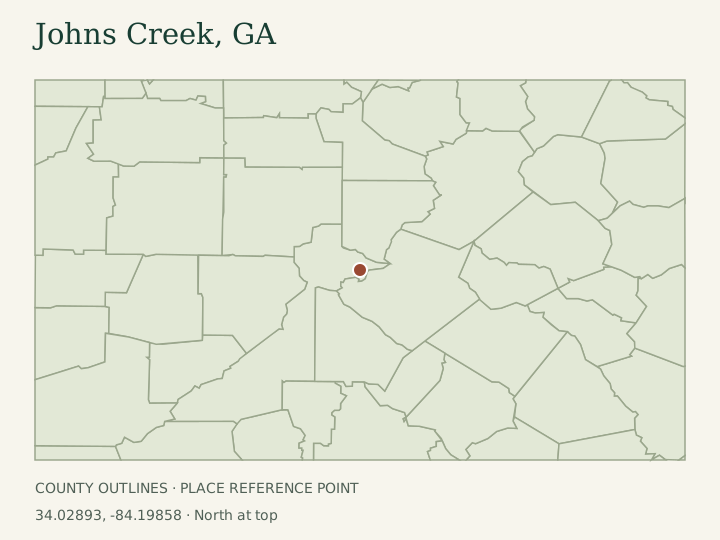
Establish the local authority and project conditions
Johns Creek’s Planning & Zoning FAQ says tree-removal permission depends on protected status or location, including specimen trees, zoning or stream buffers, required landscape strips and the Chattahoochee River Corridor. Requests go through the City’s Customer Self-Service portal. Its self-evaluation flow chart is a useful preparation aid: species, condition, location and protected areas can change the route. Ask Community Development to resolve the applicable categories for the tree rather than rely on size alone. The FAQ also provides a City-limits confirmation tool. Use the parcel and actual tree location, not an Alpharetta mailing address or a neighbor’s earlier permit, to establish which municipality administers the work. See the source instructions for the stated scope.
Separate private care from public-tree work
Johns Creek’s current Land Development page treats clearing, grubbing and related ground disturbance as distinct from a simple branch-care request. It describes land-disturbance review at 1,000 square feet and potential smaller-project review where erosion, adjoining land or drainage could be affected. It also states that natural waters have a 50-foot undisturbed buffer and an additional impervious-surface setback. Ask Land Development to establish which protected areas and current requirements affect the actual project. A pruning agreement should not quietly include buffer clearing, equipment disturbance or stump removal. Ask the assessor for species-aware timing and a retained-canopy objective, then list any proposed ground work separately for authority review. A previously indexed tree-preservation guide returned 404 and is not used as current authority here. See the source instructions for the stated scope.
Choose an eligible destination before leaving wood
Johns Creek lists multiple permitted waste haulers rather than a single universal municipal tree-material collection arrangement. Its Garbage & Recycling page describes residential service levels including yard trimmings and advises owners to ask haulers about additional charges. The listing does not verify that a particular account accepts a contractor’s tree load, heavy logs, stumps or a large storm pile. Ask the property’s selected hauler about each material and generator before using that service in an estimate. The private tree company should identify the receiving operator for excluded loads and confirm admission. A listed maximum service price is not a tree-removal price or proof of one company’s available capacity. See the source instructions for the stated scope.
Keep routine arrangements distinct from storm response
Johns Creek’s self-evaluation chart treats protected-location and tree-condition questions separately. In a stream buffer, it asks for an arborist report for a dead tree and retains limits on stump removal and motorized access even where removal is granted. Do not interpret wind damage as permission to clear a buffer or drive equipment to every tree. Immediate threats belong with emergency services and the serving utility. Once the area can be assessed, ask Community Development which documentation and current conditions apply to later work. Separate standing-tree recovery from detached-material transport and verify the actual hauler’s acceptance; the waste-hauler list does not establish an active special storm program. See the source instructions for the stated scope.
Choose the right request and compare written scopes
If the condition of a tree is undecided, request an assessment before buying a predetermined removal. Identify whether the next step is retention advice, pruning, approved removal or hauling material that is already safely detached. Give bidders the same tree labels and access information, then request written inclusions for cutting, material transport, stump work and restoration. Confirm insurance and any required credentials directly. Keep the responsible authority’s instructions with the accepted scope, and record who addresses each excluded item. The linked quote-comparison guide develops this purchase checklist; the local sections here establish the municipal decisions that must come first.
A Johns Creek work-brief example
Use this as a planning example, not a report of a completed job. A property has a declining tree near a stream and separate pruning needs beside the driveway. Confirm City limits and show Community Development the tree locations and any protected areas. Ask the assessor to separate the two objectives. Contact the property’s selected hauler about the proposed material. A removal decision does not automatically authorize stump grinding, unrestricted equipment access or every cleanup route.
Use the procedure for the actual municipality
Johns Creek’s flow chart separately addresses buffers, specimen trees and River Corridor conditions. Roswell’s FAQ uses its own permit and Planning & Zoning route, so confirm the actual municipality before submitting a request. For a property there, continue with the Roswell tree-work overview. Separate authority and collection decisions apply; this link does not establish provider coverage.
Before accepting the scope
- Authority: Johns Creek Community Development and the property’s selected waste hauler: identify the tree, project and applicable decision.
- Scope: List assessment, pruning or removal separately from hauling and ground work.
- Access: Agree protection for surfaces, retained roots and shared routes.
- Material: Confirm the actual receiver, load category, transporter and collection date.
Questions about this work
Which local question should I resolve first?
Identify the property and the tree’s public or private status, then ask Johns Creek Community Development and the property’s selected waste hauler about the relevant local process. Owner permission, a professional recommendation and an authority decision are separate.
Can I leave all removal material for routine collection?
Use the specific local material category and account eligibility. Johns Creek lists multiple permitted waste haulers rather than a single universal municipal tree-material collection arrangement. Ask the operator about large wood, stumps, contractor loads and the intended date before accepting an estimate that leaves them.
How do I compare companies without a local price claim?
Give bidders the same tree labels, authority information, access constraints and desired finish. Request itemized written scopes and verify insurance and required qualifications directly. The comparison should resolve differences in work and cleanup before comparing totals.
Sources and scope
Checked: November 3, 2026. Municipal instructions apply within the named City. Regional tree-care guidance, utility work and receiving instructions retain their own scopes. Individual parcel permission, load admission and provider coverage still need project-specific confirmation. Dated documents are identified in the text; confirm current requirements for the actual property and load. Work-brief examples are hypothetical planning aids. No site inspection, individual contractor verification or receiver admission has been completed for your project.
Nearby field guides
Great-circle distances between GeoNames place points, not driving distances or service coverage. Showing up to eight nearest published guides.
Preparing your local map…
The map loads automatically as you approach it. City links work without JavaScript.
Distances between GeoNames place points, not driving distances or service coverage. US Census January 2025 state/county boundaries, not municipal limits. Points: GeoNames, CC BY 4.0. Map interface: Leaflet.