
Tree services in Suffolk, VA
Plan removal, tree trimming or fallen-tree cleanup using the local checks below. For service scope, start with tree removal, trimming and pruning or storm damage work.
Tree services in Suffolk



Virginia tree-work decisions
In Suffolk, identify the tree's setting and the waste route before choosing a cutting service. A reservoir-edge property, an ordinary yard and a roadside problem can require different conversations. Start with Planning for possible protected-buffer work, Public Works for public infrastructure, and a written private work brief for the tree itself.
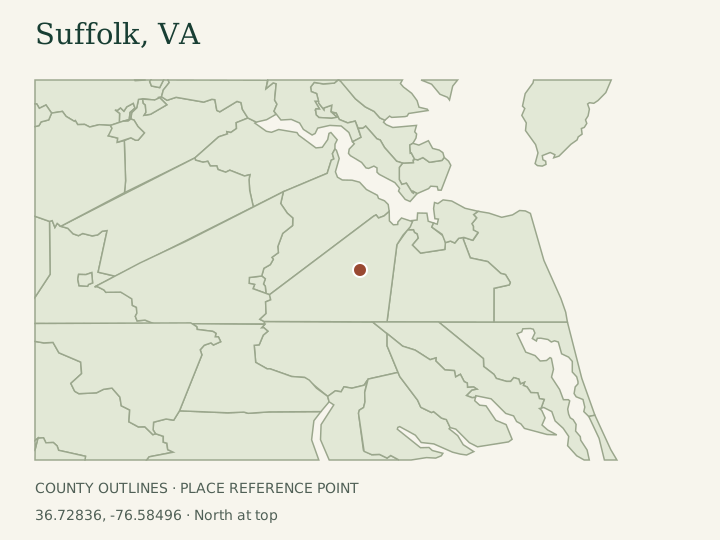
Begin with the property, not the postal address
Suffolk's Resource Protection Area explanation includes drinking-water reservoirs as well as tidal shores and connected wetlands. That matters beyond obvious Bay-front lots. If a project approaches a lake, tributary or vegetated shoreline, ask Planning to confirm the applicable area and what the proposed equipment route would disturb. A place-point map cannot settle that question.
Use the parcel reference, photographs taken from safe ground and a sketch showing the tree, water, driveway and proposed access. Describe whether you want a broken branch assessed, a whole tree removed, or several trees cleared. Those requests are materially different. Do not describe wholesale vegetation clearance as routine trimming simply because the invoice would use that word.
Match the service to the outcome
A removal brief should explain why retaining the tree may be unsuitable, whether an assessment is still needed, and what happens to the stump and wood. A pruning brief should identify the branch conflict and the crown to retain. Storm work should begin with threats to people, structures and lines before considering how to haul the resulting pile.
An arborist's findings, public permission and a contractor's price answer separate questions. Keep each decision in the project file. Where the recommendation is uncertain, commission the assessment before accepting a cutting package. Ask what observations would change the recommendation and whether follow-up inspection is part of the proposed care.
Protected vegetation changes the work plan
Suffolk's Planning FAQ describes oversight of mitigation for vegetation removal and land disturbance within the RPA buffer. Include temporary access in your question: a retained tree does not prevent machinery or material storage from disturbing surrounding vegetation. Ask staff which review fits the actual proposal and keep the answer with the agreed work boundaries.
For example, removing one damaged tree near a reservoir could involve a narrow extraction route through other plants. Have the estimator describe that route before Planning considers the scope. A low cutting price is difficult to compare with another offer if only one includes the protection and restoration needed for the selected route.
Resolve Suffolk's conflicting pickup information
The service-change FAQ effective July 2025 says the annual Special Pick-Up limit was lifted. The live Special Pick-Up page still refers to twelve per service year. Both discuss ordinary household collection, so ask Refuse to confirm the current allowance before relying on another collection. We have not treated either page as proof of unlimited contractor debris acceptance.
The service page sets preparation limits, including a twelve-cubic-yard pile, limbs under six feet long and a maximum twenty-four-inch diameter. Those are curbside rules. They do not establish the specifications for a regional receiving facility. Keep the collection program and the destination named separately in your written plan.
Give hired waste an explicit destination
The older municipal refuse brochure excludes waste produced by contracted tree removal and pruning. Its other annual-limit information is dated, and the newer service-change notice does not clearly replace that contractor exclusion. Ask for current confirmation; meanwhile have hired-work estimates include lawful removal of the material rather than assume City collection.
For a possible household self-haul, check SPSA's regional residential guidelines. Their transfer-station branch dimensions differ from Suffolk curbside limits, and commercial classification depends on more than the address where wood originated. Ask the receiving operator about the actual load, vehicle and source. Do not unload an oversized tree into a residential route because smaller branches are listed as acceptable.
Turn the findings into a comparable request
Send prospective firms the same marked-tree photos, objective, access limitations and required finish. Ask for a recommendation, protection method, separate stump scope, hauling destination and change-order process. Request insurance information directly and verify any claimed arborist credential rather than treating a business name as proof.
Use Suffolk Public Works' request route for a public roadway or drainage concern, with its location and the obstruction described. Private assessment and public reporting can proceed as separate tasks. If a tree or wire presents immediate danger, keep people clear and use emergency reporting rather than wait for a routine online ticket.
Questions about this work
Can the same pile dimensions be used for curbside and SPSA disposal?
No. Suffolk's Special Pick-Up page and SPSA's residential transfer-station rules describe different programs. Confirm eligibility and preparation for the chosen route before the material is cut or loaded.
Does a lake behind the yard matter for tree work?
It can. Suffolk includes drinking-water reservoirs and their buffers among its RPA components. Ask Planning about the parcel and proposed disturbance rather than assume only tidal waterfront is relevant.
Should I hire removal before asking about a public obstruction?
Report the public concern first, or in parallel with obtaining private assessment. State where the trunk, fallen portion and affected road or drainage feature lie. Public reporting does not itself authorize private cutting.
Nearby field guides
Great-circle distances between GeoNames place points, not driving distances or service coverage. Showing up to eight nearest published guides.
Preparing your local map…
The map loads automatically as you approach it. City links work without JavaScript.
Distances between GeoNames place points, not driving distances or service coverage. US Census January 2025 state/county boundaries, not municipal limits. Points: GeoNames, CC BY 4.0. Map interface: Leaflet.