
Tree services in Point Venture, TX
Plan removal, tree trimming or fallen-tree cleanup using the local checks below. For service scope, start with tree removal, trimming and pruning or storm damage work.
Tree services in Point Venture



Local tree-work decisions
Point Venture tree work begins with the lot-clearing rules, the tree’s location and the planned material route. Routine pruning, protected-tree removal and work in a floodplain need different questions. Check those questions with the village before turning a broad cleanup request into a cutting contract.
Separate pruning from clearing and removal
Point Venture’s code treats lot clearing as more than an empty-lot maintenance label. The permit section addresses clearing vacant lots and removing protected trees on any lot. Start by identifying whether the proposal removes a tree, changes the land or only trims branches. A contractor’s description of “cleanup” does not resolve those distinctions.
The local definitions also identify the building official as the administrator of lot-clearing, landscaping and drainage regulations. Send that office an address, photographs taken from safe ground, the intended work and any construction plans. If the property is near a mapped flood-hazard area, flag that early. The code includes a floodplain provision whose relationship to exemptions should be resolved before the crew starts.
Measure for the right question
The protected-tree definition uses a measurement near the base, rather than a generic breast-height rule copied from another city. It identifies a trunk diameter greater than four inches measured one foot above ground and excludes Ashe juniper from that protected-tree category. That exclusion does not settle every lot-clearing or floodplain question.
Ask an assessor to identify the species and record the applicable measurement where safe. On an irregular trunk, a photograph or rough homeowner measurement may need confirmation. Do not ask a crew to cut first and let a remaining stump establish the permit facts. If the problem could be addressed while retaining the tree, obtain an assessment recommendation before committing to removal. Approval requirements and biological condition are separate decisions.
Prepare the application before mobilizing
The village’s lot-clearing application process calls for landscape and grading information, including existing vegetation, proposed removals and drainage. For a construction-related project, the tree work should match the plan submitted for the property. Do not assume a verbal clearing discussion replaces those materials.
Agree who will prepare the plan, submit the request and keep the final authorization. Give the contractor the accepted limits and retained-tree locations. If an estimate depends on more extensive removal than the application describes, correct the discrepancy before signing. Ask the building official which information is necessary for your specific project rather than using an oversized new-build checklist to justify unnecessary work on an established home.
Collection-center delivery is different from cutting
The official 2026 trash schedule lists a collection-center route for brush and limbs at 18606 Venture Drive. The schedule identifies opening dates; it does not establish every load limit, contractor privilege or stump acceptance condition. Confirm those details before arranging transport or excluding haul-off from an estimate.
Make a material list: small branches, large sections, chips, stump material and any mixed debris. Ask the receiving operator about the exact categories you have. A tree service can quote cutting without hauling, but that leaves you with a separate transport and acceptance problem. A credible cleanup plan states who retains each material and who pays for a refused load or an additional trip. Do not mistake ordinary bin collection for permission to leave a whole removal at the curb.
After a storm, report first and scope recovery
The village’s emergency-services page identifies emergency responders. An immediate threat to people belongs with emergency services, while an electrical conflict belongs with the utility operator identified for that line. Keep a safe distance and avoid approaching damaged limbs for better photographs.
The lot-clearing code includes an emergency reporting requirement for actions taken without a permit. Ask the building official how it applies, especially where floodplain provisions are involved. Record what was necessary to address the hazard and separate it from later elective clearing. For scheduled recovery, request an assessment of retained trees as well as prices for cutting and transporting detached material. Routine collection-center access does not promise disaster-scale debris acceptance.
Use one written brief for every bidder
A useful brief might request review of two marked trees, confirmation of whether the proposal needs village authorization, a retained-tree protection plan and a price that distinguishes removal from stump work. Add the available access width and the locations of surfaces or buried services the crew must protect. Request an explanation of any change that would alter the submitted plan.
Compare exclusions before comparing totals. An estimate with transport and receiving costs can be more complete than one that leaves a pile for you. Confirm who handles debris preparation, traffic or access coordination and final inspection of the work area. Keep an approval-dependent start date flexible until the required review has been completed. No directory listing establishes a contractor’s availability, qualifications or the village’s approval of the project.
Local questions
Can a pruning exemption be used to clear a lot?
No. Describe the actual work. Removing a tree, changing grade or using heavy equipment can raise separate questions under the local code.
Are Point Venture and Lakeway the same review area?
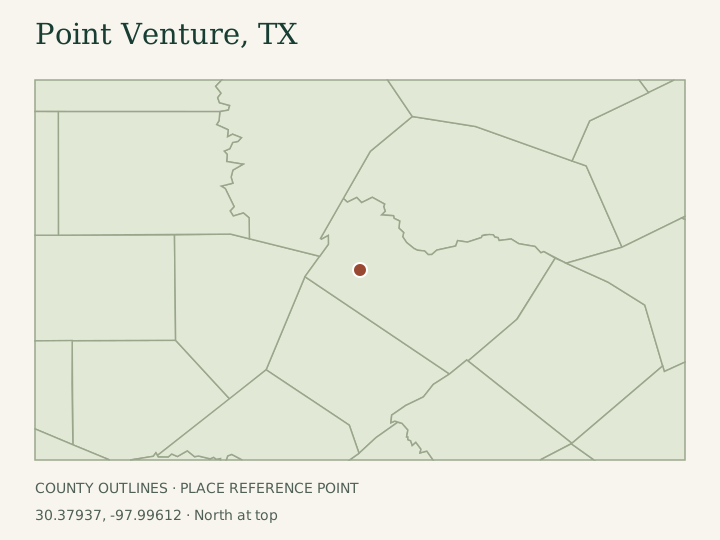
They are separate municipal authorities. The map uses straight-line place-point distances, including across water, rather than a shared jurisdiction or driving route.
Does the collection calendar approve contractor loads?
It lists a brush-and-limb route and scheduled opening dates. Confirm contractor-generated material, dimensions and eligibility directly before relying on it.
Nearby field guides
Great-circle distances between GeoNames place points, not driving distances or service coverage. Showing up to eight nearest published guides.
Preparing your local map…
The map loads automatically as you approach it. City links work without JavaScript.
Distances between GeoNames place points, not driving distances or service coverage. US Census January 2025 state/county boundaries, not municipal limits. Points: GeoNames, CC BY 4.0. Map interface: Leaflet.