
Tree services in Davis, CA
Plan removal, tree trimming or fallen-tree cleanup using the local checks below. For service scope, start with tree removal, trimming and pruning or storm damage work.
Tree services in Davis



California local tree-work decisions
In Davis, start by identifying the tree’s owner and the local decision you need: assessment, pruning, removal or disposal. Davis requires an approved permit for substantial pruning or removal of City and private protected trees.
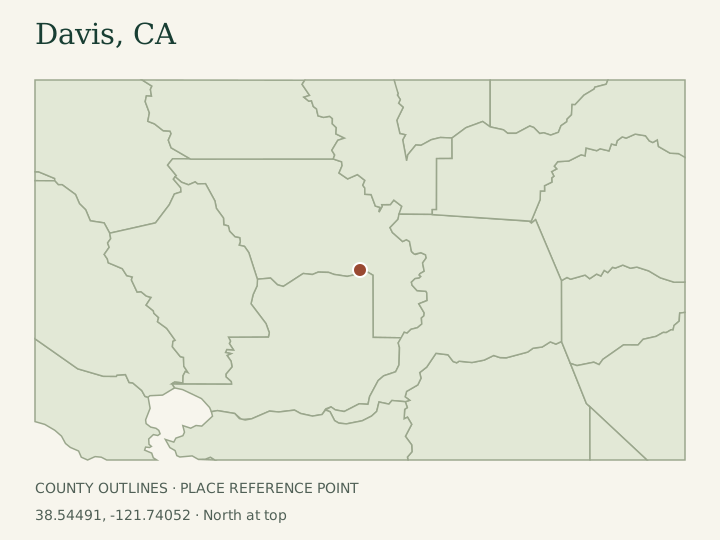
Establish the local authority and project conditions
Davis requires an approved permit for substantial pruning or removal of City and private protected trees. City trees can occupy the ten-foot easement on private land, so the fence or lawn boundary is not enough to classify ownership. Trees of Significance include qualifying commercial, multifamily and HOA common-area trees; Landmark Trees have a separate designation. The current page also says otherwise unprotected private trees become protected when a property permit is pulled, including work such as an ADU or pool. Request an ownership check and disclose the entire project. Removal conditions can include mitigation, with the Urban Forestry Program Manager deciding the actual requirement. Do not price replacement as an optional extra until staff has established the permit conditions. See the source instructions for the stated scope.
Separate private care from public-tree work
Davis distinguishes non-substantial maintenance from substantial pruning of protected trees. Use the City's current maintenance guidance and ask Forestry to classify the proposed cuts rather than treating every small-looking branch as exempt. City-tree requests are evaluated for health, safety and public clearance, and work can be performed by City staff or its contractors. Owners needing work on a particular project schedule can inquire about a City Tree Permit for work at their expense. Describe species, size, condition, the pruning purpose and methods in the application. Include root-area disturbance as well as canopy work. A painting deadline does not guarantee municipal crew availability or remove the need for approval. See the source instructions for the stated scope.
Choose an eligible destination before leaving wood
Davis excludes branches and trunks larger than eight inches in diameter from both yard-material street piles and organics carts. That limit can change the disposal component of a removal or major pruning purchase even where smaller branches fit. Street-pile collection is seasonal, and the City offers alternatives such as arranging a haul during periods without pile service. Check the actual address calendar and set-out window rather than leaving debris in the street while waiting for the next season. Give the hauler the dimensions, volume and stump description before accepting its destination. A contractor can prepare eligible detached material, but that preparation is a separate purchased task from assessing or pruning the standing tree. See the source instructions for the stated scope.
Keep routine arrangements distinct from storm response
Davis prioritizes City-tree work using tree health, public safety, clearance and available resources. After damage, identify a public request separately from an owner's private recovery order. Emergency services address immediate threats and the actual electric operator addresses line involvement; a routine permit email is not emergency dispatch. Once safe, retain photographs and ask Forestry about protected-tree work, mitigation and any required assessment. A request does not authorize an owner to commission unreviewed removal in the easement. The branch-size exclusion still matters for detached storm wood. Do not convert a seasonal street-pile arrangement into a standing promise of unlimited storm cleanup. See the source instructions for the stated scope.
Choose the right request and compare written scopes
If the condition of a tree is undecided, request an assessment before buying a predetermined removal. Identify whether the next step is retention advice, pruning, approved removal or hauling material that is already safely detached. Give bidders the same tree labels and access information, then request written inclusions for cutting, material transport, stump work and restoration. Confirm insurance and any required credentials directly. Keep the responsible authority’s instructions with the accepted scope, and record who addresses each excluded item. The linked quote-comparison guide develops this purchase checklist; the local sections here establish the municipal decisions that must come first.
A Davis work-brief example
Use this as a planning example, not a report of a completed job. A planned ADU changes the tree question on an otherwise ordinary private lot. Send the property permit context and tree labels to Forestry before selecting work. Ask which trees are protected through the project and which mitigation conditions apply. Identify oversized wood separately from material eligible for the household route.
Check the actual jurisdiction before transferring a plan
For a property in Woodland, use the Woodland tree-work overview to check that jurisdiction before transferring this plan. Woodland requires a public tree permit for specified street-tree work, including removal and major maintenance. The location of the property determines the applicable procedure; these neighboring guides do not establish shared rules or provider coverage.
Before accepting the scope
- Authority: Davis Urban Forestry and Public Works Utilities and Operations: identify the tree, project and applicable decision.
- Scope: List assessment, pruning or removal separately from hauling and ground work.
- Access: Agree protection for surfaces, retained roots and shared routes.
- Material: Confirm the actual receiver, load category, transporter and collection date.
Questions about this work
Which local question should I resolve first?
Identify the property and the tree’s public or private status, then ask Davis Urban Forestry and Public Works Utilities and Operations about the relevant local process. Owner permission, a professional recommendation and an authority decision are separate.
Can I leave all removal material for routine collection?
Use the specific local material category and account eligibility. Davis excludes branches and trunks larger than eight inches in diameter from both yard-material street piles and organics carts. Ask the operator about large wood, stumps, contractor loads and the intended date before accepting an estimate that leaves them.
How do I compare companies without a local price claim?
Give bidders the same tree labels, authority information, access constraints and desired finish. Request itemized written scopes and verify insurance and required qualifications directly. The comparison should resolve differences in work and cleanup before comparing totals.
Sources and scope
Checked: October 31, 2026. Procedures follow the named city/borough or county. State rules, utility work and receiving instructions retain their specific geography and eligibility. Dated documents are identified in the text; confirm current requirements for the actual property and load. Work-brief examples are hypothetical planning aids. No site inspection, individual contractor verification or receiver admission has been completed for your project.
Nearby field guides
Great-circle distances between GeoNames place points, not driving distances or service coverage. Showing up to eight nearest published guides.
Preparing your local map…
The map loads automatically as you approach it. City links work without JavaScript.
Distances between GeoNames place points, not driving distances or service coverage. US Census January 2025 state/county boundaries, not municipal limits. Points: GeoNames, CC BY 4.0. Map interface: Leaflet.