
Tree services in Peterborough, NH
Plan removal, tree trimming or fallen-tree cleanup using the local checks below. For service scope, start with tree removal, trimming and pruning or storm damage work.
Tree services in Peterborough



New Hampshire tree-work decisions
Peterborough tree work can involve several different Town decisions: public-tree authority, a timber-operation filing, a roadway report and recycling-center acceptance. Start by identifying which apply to your property. A household shade-tree job is not automatically a timber harvest, and the current Recycling Center brochure separates brush from yard waste and excludes stumps.
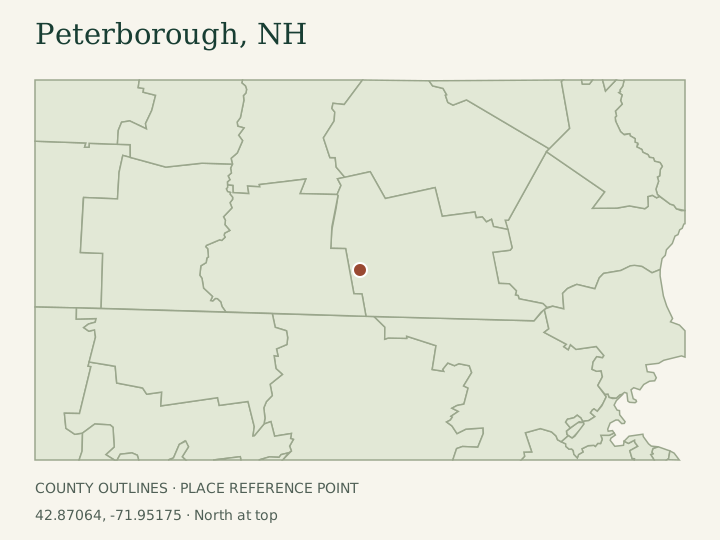
Match the property to Peterborough, New Hampshire
This guide concerns the Town of Peterborough in Hillsborough County, New Hampshire. Search results also return a Canadian city and an English council with different tree and waste systems. Use the Town's official website to reach the correct departments and confirm the street address before relying on any procedure. The GeoNames reference point is a locator, not the Town boundary or a service radius.
Peterborough Public Works identifies Highway, Utilities, Buildings and Grounds, and Recycling as separate functions. Its Highway description includes roadside mowing and debris cleanup. Ask the department to establish responsibility where a tree affects a Town road; a private driveway or tree in the rear yard may need an owner-arranged assessment instead. Public infrastructure maintenance does not establish free private-tree work.
Separate a shade-tree job from a timber operation
The Assessing Department's Intent to Cut page describes the filing and Select Board signature process for applicable timber operations. It also lists exceptions, including shade and ornamental trees, and advises owners with uncertainty to check the requirement. A tree-work estimate should therefore describe whether it is a single landscape-tree job, a broader clearing project or a timber operation before the owner assumes which process applies.
A timber-tax exception does not establish public-tree permission, a land-use approval or authority to work on another person's tree. New Hampshire's public shade-tree removal statute has its own scope. Give the Town the location and proposed extent of work and ask the relevant departments to identify the applicable decisions. Keep those answers with the contractor's plan instead of relying on the general word permit.
Ask an arborist which treatment fits the problem
Explain the reason for the visit: a branch conflict, a damaged crown, a concern about roots or proposed access for another project. Request a recommendation that compares retention, pruning and removal where appropriate. A bidder can price a removal without having demonstrated that removal is necessary; ask for the reasoning and any uncertainty that requires closer inspection before selecting the scope.
UNH Extension distinguishes immediate safety work from recovery and later inspection of damaged large trees. Use that regional technical advice to organize questions, not to diagnose your own tree from a photograph. For planned pruning, identify the species and purpose before choosing the season. Mature-tree climbing, heavy limbs and utility-adjacent work require qualified professionals and appropriate coordination.
Check the receiving route before agreeing to hauling
The current Recycling Center page identifies its Scott Mitchell Road site and permits for Peterborough and Sharon residents. The 2026 brochure limits brush to twenty-two inches or less in diameter and excludes stumps. It separates leaves, pine needles, grass clippings and garden waste from brush, and requires removal of plastic bags and pots from yard waste. A stump or mixed construction load therefore needs a separate confirmed route.
The current disposal page separately lists commercial landscape brush and accepts cash and checks. A household vehicle permit does not independently answer contractor-load eligibility. Give receiving staff the material, vehicle and hauler details before loading. If considering burning, Peterborough Fire and Rescue says written landowner permission and a local fire permit are needed; it is not an automatic substitute for a rejected load.
Give each contractor the same complete brief
For removal, identify the tree, the assessment and any Town direction, then separate wood hauling, stump work and surface restoration. For pruning, identify the retained canopy and branch objective. After a storm, distinguish immediate risk control from assessment and cleanup. Include access limits and protection of nearby property so bidders can assess a workable method rather than make incompatible assumptions.
If you manage another property toward Keene, use the Keene tree-work guide for its City reporting and Old Summit Road instructions. Keene's published brush category and leaf program are not Peterborough rules, and a regional destination still needs its own eligibility confirmation. Keep jurisdiction and receiver questions attached to each address even when one contractor proposes the combined work.
Questions about this work
Do all tree removals need an Intent to Cut?
Peterborough's Assessing page describes applicable timber operations and lists exceptions that include shade and ornamental trees. Ask Assessing where your project is uncertain, especially when landscape work expands into clearing. The answer does not replace public-tree permission or other site-specific reviews.
Can I use an old recycling-center brochure to plan a contractor load?
Use the 2026 brochure and current disposal page instead. They distinguish brush, yard waste and commercial landscape loads, with a stump exclusion. Confirm the actual vehicle, material and eligibility before hauling; an old archive document or household permit does not settle every contractor arrangement.
Who receives a roadway concern outside office hours?
The current Public Works page directs nonbusiness-hours contact through Peterborough Police, and immediate emergencies to 911. Describe the address and whether wires are involved. Contact the actual line operator for electrical hazards; a roadway report does not establish electrical clearance or a private tree-work appointment.
Nearby field guides
Great-circle distances between GeoNames place points, not driving distances or service coverage. Showing up to eight nearest published guides.
Preparing your local map…
The map loads automatically as you approach it. City links work without JavaScript.
Distances between GeoNames place points, not driving distances or service coverage. US Census January 2025 state/county boundaries, not municipal limits. Points: GeoNames, CC BY 4.0. Map interface: Leaflet.