
Tree services in Crestview, FL
Plan removal, tree trimming or fallen-tree cleanup using the local checks below. For service scope, start with tree removal, trimming and pruning or storm damage work.
Tree services in Crestview



Florida tree-work decisions
In Crestview, tree work connected to clearing or development needs a site-based review, while routine trimming and household collection raise different questions. Start with the parcel and the purpose of the work. Keep stumps, root balls and lot-clearing debris out of any assumed ordinary yard-waste route.
Describe the project before choosing the process
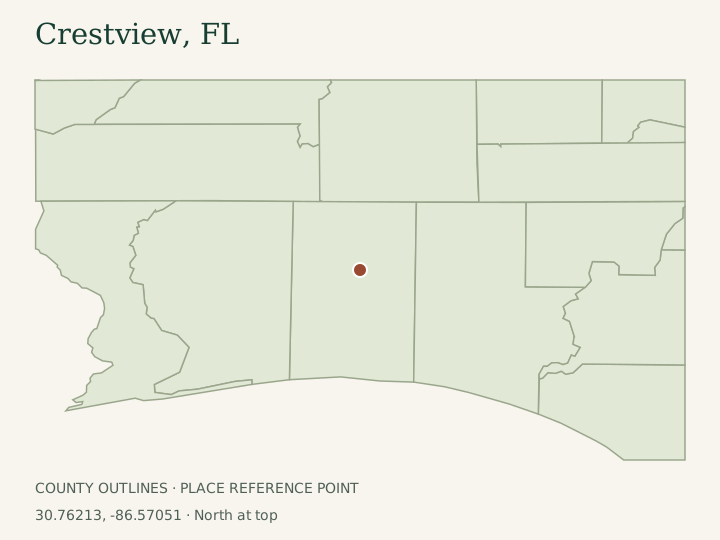
This guide concerns the City of Crestview in Okaloosa County. Identify the actual parcel jurisdiction before using city guidance; a Crestview postal address may describe a wider area. Tell Community Development whether you are assessing one tree, proposing pruning, removing a protected tree or clearing vegetation for a project.
The land-clearing and protected-tree removal form asks for site information, including easements, wetlands and floodways. That makes a marked plan more useful than an instruction to clear everything behind a fence. Ask which documents apply to your scope. The existence of a development form is not evidence that every small maintenance task requires a complete development submission.
Inventory trees that stay as well as those that go
The form requests species, diameter, crown spread and condition for protected trees proposed for removal. It also distinguishes retained, removed, dead and replacement trees. Label the tree or group consistently in the assessment, city correspondence and estimate. A list helps prevent a crew interpreting a broad site-clearance instruction as permission to remove a tree intended to stay.
For a single concern, ask what an on-site assessment can establish about retention. A tree near construction might be protected by changing access or design rather than removing it. Discuss root-zone and equipment protection with the contractor. If there is an immediate hazard, route that separately instead of extending the urgent work to optional clearing.
Resolve protected-tree and property questions
Crestview’s Land Development Code, section 6.08.09, addresses protected trees and removal or damaging work. Have the city apply the current provisions to the species, condition and parcel rather than relying on an informal diameter guess. The form’s final review records approval, denial or conditions; keep the resulting instructions with the work brief.
Florida’s documented-risk provisions may affect a qualifying residential project, but ordinary clearing should not be relabeled as emergency tree work. Ask the assessor and authority which route applies and retain the records. Easements, ownership and environmental restrictions need separate attention. An answer about a tree does not automatically authorize grading, changes to drainage or equipment access over neighboring land.
Use the correct household or receiving-facility route
The city solid-waste FAQ gives preparation limits for routine limb bundles and a way to report missed service. Confirm account eligibility and ask about contractor-generated or oversized wood before planning around curbside collection. General bulk household service and yard material are different categories.
For larger woody material, Okaloosa County identifies Baker and Wright yard-waste facilities. Baker’s list excludes stumps, root balls and land-clearing debris. The page’s introductory and detailed dimensions differ, so confirm the load with the chosen facility. A contractor hauling branches from a small job and a contractor clearing a lot may need different receiving arrangements.
Compare an authorized finished project
For example, a homeowner adding an improvement can request an assessment of one marked tree, review of whether it must be removed and a proposal protecting adjacent retained trees. The estimate should distinguish that task from general land clearing, identify hauling and describe the stump endpoint. This keeps both the review and the price tied to an intelligible project.
Record gate access, usable ground, buried-service concerns, equipment staging and cleanup expectations. Ask who handles load rejection, additional trips and restoration of disturbed areas. If grinding is proposed, identify who arranges buried-service checks and where grindings will remain. Avoid treating a quoted removal total as a promise that the space will be ready for new construction or planting.
Questions about this work
Does the development form cover every pruning request?
Do not assume it does. Explain the species, scope and parcel to Community Development and ask which current requirements apply.
Can Baker accept stumps with tree limbs?
The county facility list excludes stumps and root balls. Arrange their destination separately and confirm the receiving route before hauling.
Does a city water bill prove every tree-work rule?
Service accounts and legal jurisdiction answer different questions. Check the parcel and the relevant city or county authority directly.
Nearby field guides
Great-circle distances between GeoNames place points, not driving distances or service coverage. Showing up to eight nearest published guides.
Preparing your local map…
The map loads automatically as you approach it. City links work without JavaScript.
Distances between GeoNames place points, not driving distances or service coverage. US Census January 2025 state/county boundaries, not municipal limits. Points: GeoNames, CC BY 4.0. Map interface: Leaflet.