
Tree services in Kittery, ME
Plan removal, tree trimming or fallen-tree cleanup using the local checks below. For service scope, start with tree removal, trimming and pruning or storm damage work.
Tree services in Kittery



Maine tree-work decisions
In Kittery, determine whether tree work affects a public space or a shoreland/resource-protection overlay before accepting a cutting proposal. Then plan the waste stream: Kittery's facility distinguishes brush, nonwoody yard waste and stumps, with resident access requirements that do not automatically cover a contractor's truck.
Start with the decision at this property
Describe the outcome before asking for a price. A crown assessment, limited clearance pruning and complete removal should not be interchangeable responses to the same photograph. Ask the person assessing the tree to explain observed defects, what can reasonably remain and any access constraints. Identify each tree so a broad “yard cleanup” instruction cannot expand into unwanted removal.
If wires, hanging limbs or newly unstable trees are involved, keep people out of the area and use the appropriate emergency or utility route. CMP warns that downed wires may be hidden in tree debris. Report the location from a safe position rather than moving branches to investigate. Ordinary quote comparison begins after the immediate hazard has been addressed by the responsible parties.
Separate overlay review from timber harvesting
Kittery Code Enforcement reviews vegetation removal in shoreland and resource-protection overlay zones. Check the actual parcel and activity with that office instead of assuming that owning the tree resolves land-use permission. An inland maintenance request and a proposed opening toward the water can involve materially different review questions.
The Town's shoreland property information separately identifies the Maine Forest Service's role in timber harvesting. Do not classify a landscape project as forestry simply because several trees will be cut, or assume a forestry notification answers all municipal development questions. Bring an address, location sketch and description of access and soil disturbance. Ask which authority must decide each part before work begins.
Match professional responsibility to the service
Maine's arborist program requires the applicable license for covered work, including compensated developed-area tree removal, diagnosis and elevated pruning. Verify the individual accepting that responsibility and obtain current insurance evidence. The state lists chipping and stump grinding separately outside that arborist-license definition, so a cleanup operator's equipment does not establish standing-tree assessment qualifications.
A state license also does not replace utility coordination, landowner consent or the Town's review. Ask who supervises subcontractors, who decides whether the tree can remain and who handles any change in the work. Keep the records together. This guide has not checked a particular provider's credentials or established that a referral service is available at the property.
Plan three different material streams
Kittery's facility materials page identifies limbs, branches and trunks as brush/wood waste and says stumps must be kept separate. Its April 13, 2026 disposal schedule distinguishes nonwoody yard waste from brush/branches. Do not turn a free leaves category into a claim of free removal for an entire tree or assume a root ball belongs in a branch pile.
Use the material description to obtain a real receiving decision: branch sizes, log quantity, stump condition, contamination and vehicle. Confirm current charges before travel. Municipal acceptance is a waste-management question, separate from permission to cut the tree. Storm-damaged fencing, wire or construction debris should not be hidden in a clean woody load.
Check whose sticker and vehicle qualify
The Town's sticker instructions describe annual resident facility access, with expiration one year from the issuance month and registration or acceptable proof of residency. Ask about the actual vehicle and load if a contractor, landlord or another person will make the trip. A resident's decal is not proof that a paid commercial hauling arrangement qualifies.
For an Eliot address, consult the Eliot tree-work guide: that Town prohibits commercial dumping at its transfer station and identifies a different receiving problem. Kittery and Eliot share a region, but their municipal instructions remain separate. Check the job jurisdiction and the receiver rather than choosing rules according to the closest facility or a contractor's preferred route.
Put the whole project in a written brief
For removal, name the tree, recommendation, applicable review, hauling destination and stump finish. For pruning, specify the objective and retained crown, then the timing and brush handling. For storm work, separate hazard control, standing-tree assessment and debris transport. This is more useful than comparing totals for three different interpretations of “tree service.”
UMaine's pruning guidance explains species and growth-response considerations and advises against topping trees. Ask how those considerations affect your proposed work rather than treating a general seasonal calendar as a diagnosis. Agree equipment access, retained-root protection and surface restoration. Use Kittery Public Works and Town Alerts for public-space concerns and storm-related schedule changes; a municipal report does not promise a private-yard crew or a completion time.
Questions about this work
Is Kittery Point a separate tree-work authority?
This guide follows Town of Kittery instructions, whose Public Works page explicitly includes Kittery Point residents in its facility description. Confirm the actual parcel and any special jurisdiction instead of creating a different rule from a place name.
Does accepting stumps mean they can be mixed with brush?
No. The Town instructs users to keep them separate. Confirm size, soil and contamination conditions and the current charge with the facility before arranging hauling or signing a cleanup scope.
Does a Maine arborist license authorize shoreland removal?
The license addresses the professional's covered work. It does not decide the property's overlay conditions or replace Town review. Obtain the relevant property determination and the contractor's qualifications separately.
Nearby field guides
Great-circle distances between GeoNames place points, not driving distances or service coverage. Showing up to eight nearest published guides.
Preparing your local map…
The map loads automatically as you approach it. City links work without JavaScript.
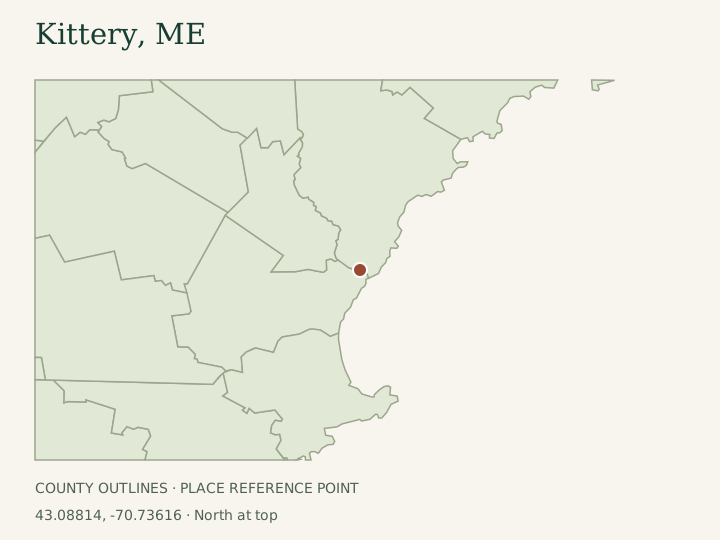
Distances between GeoNames place points, not driving distances or service coverage. US Census January 2025 state/county boundaries, not municipal limits. Points: GeoNames, CC BY 4.0. Map interface: Leaflet.