
Tree services in Eliot, ME
Plan removal, tree trimming or fallen-tree cleanup using the local checks below. For service scope, start with tree removal, trimming and pruning or storm damage work.
Tree services in Eliot



Maine tree-work decisions
For tree work in Eliot, first identify the property and the proposed activity, then choose a qualified person and a material destination. The Town's transfer station prohibits commercial dumping, so a contractor's hauling plan needs attention before the cutting starts. A shoreland project also needs a different conversation from an ordinary inland maintenance request.
Turn the concern into the right work request
A tree rubbing a roof, a declining crown and a fallen trunk across a driveway do not call for the same purchase. Describe what you can observe from a safe position: the affected tree, nearby structures, the branch conflict and whether access is blocked. Ask for an assessment when the cause or remedy is uncertain. Ask for a removal proposal only when the reason for removing the whole tree has been explained.
Keep electrical dangers separate from quote shopping. CMP's storm information warns that tree debris may hide downed power lines. Stay out of the debris and report the hazard to the line operator; use emergency services for an immediate threat to people. A quiet wire or a restored neighboring house does not establish that a tree is safe to approach.
Use the Town of Eliot for the actual address
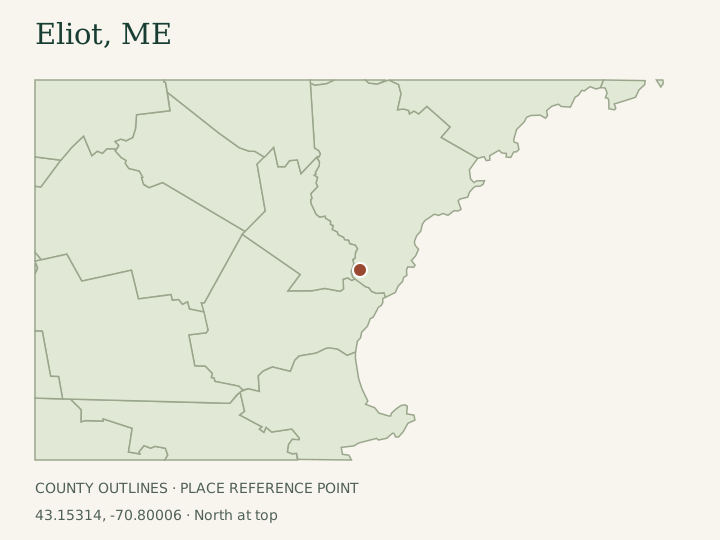
This guide follows the Town of Eliot, Maine. South Eliot is a populated-place name in the inventory, not an additional municipal government with its own transfer-station rules. Give officials the street address and map/lot reference when available. A postal address, neighborhood label or a contractor's service area cannot determine which land-use conditions apply.
Eliot Code Enforcement supplies ordinances and permit information but explicitly distinguishes those services from property-specific feasibility studies, surveying and design. Bring a clear work description and ask which current requirements govern that activity. The Town's applications directory includes a shoreland zoning application. Its presence is a reason to check the property and activity, not proof that every backyard branch needs a permit.
Select an arborist for the work being purchased
Maine has a meaningful licensing distinction. The state's arborist licensing guidance includes compensated diagnosis, developed-area tree removal and pruning that requires leaving the ground. It separately excludes activities such as chipping and stump grinding from that arborist-license definition. A firm offering cleanup machinery therefore has not automatically demonstrated the authority or training for a standing-tree assessment.
Ask who will diagnose the tree, who will supervise the work, and which license category covers that person's role. Verify the individual rather than relying on an advertisement's word “certified.” Request current insurance evidence appropriate to the work. A license, an insurance policy, property permission and the utility's line-clearance requirements answer different questions; keep all four in the project file where applicable.
Decide the receiving route before loading wood
The Town's transfer-station guidelines prohibit commercial business dumping. Its station page identifies 468 H.L. Dow Highway and Wednesday/Saturday opening days. These details are useful for checking a resident's own trip, but they do not authorize a paid crew to use the facility or establish acceptance of every size of log, root or stump. Confirm the resident material rules and any closure before travel.
A separate receiving option is York Woods Tree's green-waste operation in Eliot. Its own instructions list clean brush and prunings, accept stumps free of rocks, require separation by category and exclude invasive material including Japanese knotweed. This is a private receiving business, not a Town benefit or a recommendation of its tree services. Ask about the particular load, charges and vehicle before including that route in an agreement.
Write one scope that separates the decisions
For a scheduled project, request an itemized description of assessment, authorized cutting, access protection, wood handling and final ground condition. Note whether logs stay on the property, whether branches are chipped, whether chips remain, and whether stump grinding includes removal of grindings and soil restoration. “Clean up” is too imprecise to compare across proposals.
Use a practical example: if one proposal leaves all logs and another hauls them, they are different purchases even when both say “tree removal.” If one assumes a contractor can use the municipal station, have that assumption corrected before acceptance. The Kittery tree-work guide explains a different municipal receiving system with resident stickers and separate stump handling. Those Kittery instructions do not create admission rights for an Eliot load.
Match timing and access to the goal
For pruning, UMaine's woody-plant guidance ties timing to species, growth and the intended result. Its dormant deciduous-tree guidance does not turn a whole calendar month into a universal rule for every evergreen, flowering tree or urgent defect. Ask the assessor to explain what should happen promptly and what can be scheduled for a suitable season.
Before equipment arrives, agree the gate route, lawn protection and restrictions around retained roots, septic features and drainage. Arrange any excavation-location requests through the appropriate process before stump or ground work. Photographs and an access sketch can make estimates clearer; they do not replace an on-site judgment about tree condition, ground bearing or utilities. Keep records of the accepted scope and any later change.
Questions about this work
Can the contractor use my resident transfer-station access?
Do not build the contract on that assumption. Eliot's current guidelines prohibit commercial dumping. Ask the station about your own eligible material and have the contractor name a lawful receiving arrangement for its hauling.
Does the Town decide whether my tree can be saved?
Code Enforcement supplies requirements and ordinance information within its role. An arborist's condition assessment is a separate service. Ask each professional or office the question it is equipped to answer, particularly where shoreland conditions may affect the work.
Is chipping the same service as tree care?
No. Maine separates chipping from covered arboriculture in its licensing guidance. A cleanup-only agreement should identify who, if anyone, is responsible for inspecting standing trees and addressing defects that remain after debris is removed.
Nearby field guides
Great-circle distances between GeoNames place points, not driving distances or service coverage. Showing up to eight nearest published guides.
Preparing your local map…
The map loads automatically as you approach it. City links work without JavaScript.
Distances between GeoNames place points, not driving distances or service coverage. US Census January 2025 state/county boundaries, not municipal limits. Points: GeoNames, CC BY 4.0. Map interface: Leaflet.