
Tree services in Bennington, VT
Plan removal, tree trimming or fallen-tree cleanup using the local checks below. For service scope, start with tree removal, trimming and pruning or storm damage work.
Tree services in Bennington



Vermont tree-work decisions
Plan Bennington tree work around three separate questions: who controls the tree, what an assessment recommends, and where each type of cut material can go. Town roadside questions start with Public Works; covered public shade trees involve the Tree Warden. The transfer station on Houghton Lane is a receiving destination to check, not a promise that every tree load qualifies.
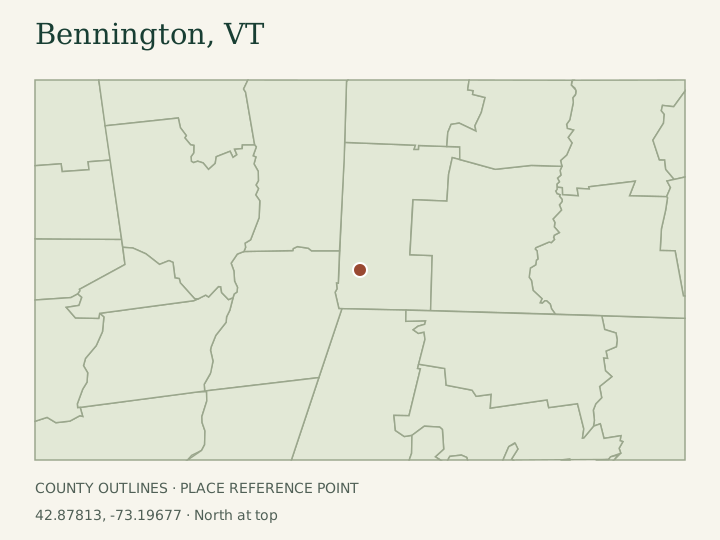
Identify the town, village and road authority first
A Bennington mailing address does not settle the authority over a roadside tree. The Town website separately links the villages of North Bennington and Old Bennington. Confirm the actual location and road manager before requesting permission or relying on a municipal maintenance arrangement. This guide follows Town of Bennington sources; it does not extend Town decisions to every separately administered village street.
Send Bennington Public Works the property address, nearby intersection and a photograph taken from a safe position. Ask whether the affected tree is in a Town right-of-way and which official should review the proposed work. For a tree entirely within private land, ask Planning and Permitting about any site-specific restrictions rather than interpreting the absence of a public-tree issue as approval for the whole project.
Choose an assessment before a cutting package
Describe the problem in terms the assessor can investigate: a broken branch over the entrance, an expanding crack, obstruction of a sign, or interference with planned equipment access. Those observations support a useful inspection. They do not establish that a tree must be removed. Ask for the recommendation and the reason in writing, including whether selective pruning, monitoring or another treatment could meet the objective.
For mature trees, a qualified arborist should evaluate the structure and targets on site. UNH Extension's large-tree guidance distinguishes making a damaged tree safe from its later recovery work. That is regional technical guidance, not a Bennington permit rule. A retained tree may need follow-up; a removed tree may still leave a stump, roots and a disturbed equipment route unless the contract addresses them.
Apply the Vermont shade-tree framework accurately
Vermont's Parks and Shade Trees chapter defines the covered shade-tree category through municipal planting or designation in a public way or place. It gives the Tree Warden control and generally requires the Warden's written permission for others to cut or remove covered trees, subject to the statutory framework. This is not a diameter-based permit requirement for every tree on private property.
If a roadside location is uncertain, get a determination before selecting a work date. The Vermont forestry program explains why the land beneath a right-of-way and the authority to maintain its trees can differ. Keep a copy of any direction with the quote so a crew does not mistake a homeowner's instruction for authorization over public assets.
Arrange the receiving route before hauling
The Bennington County Solid Waste Alliance identifies the Bennington station at 904 Houghton Lane and lists Bennington, North Bennington, Old Bennington and Woodford as its service area. It also identifies the Long Trail organics facility as not open to the public. A nearby composting operation is therefore not an interchangeable drop-off point for a resident or tree contractor.
The Alliance's linked October 2023 sheet distinguishes commercial and residential brush loads. The Town's live station page still posts the revised 2023 schedule and distinguishes brush from leaves and other yard waste differently. It says local residents need a sticker obtained through the Town Collections desk. Neither historical sheet establishes today's charge. Give the station the load description, hauler type, expected log sizes and any stumps; obtain current acceptance and payment instructions before the truck leaves the property. Vermont's wood and yard-debris guidance also keeps these materials out of ordinary trash.
Turn those answers into a comparable work brief
For a removal, identify the exact tree and the agreed stump height, then separate trunk disposal, stump work and final grading. For pruning, identify the branch conflicts and canopy to retain. For storm damage, separate immediate hazard control from the later standing-tree assessment and loading work. Ask each bidder to use that same description so one total does not quietly exclude the most expensive cleanup step.
Record the equipment entry, lawns or retained trees to protect, permission for neighboring access, and responsibility for repairing ruts. If your project crosses south into Massachusetts, consult the Great Barrington tree-work guide; its Conservation review and Massachusetts public-tree process are different from Bennington's Vermont framework. The comparison helps identify the proper authority for each property, without implying a shared permit or provider network.
Questions about this work
Will the Town take down a tree in my yard?
Public Works can establish the road and public responsibility; that does not promise private-tree service. A private assessment and written scope may still be needed. Explain the location and hazard, then obtain a clear answer about which part, if any, is municipal work.
Can my contractor use my residential brush arrangement?
Do not assume that. The published historical station sheets distinguish commercial loads, and the operator needs the actual hauler and material description. Ask about eligibility, payment and exclusions before assigning hauling in the contract; a residential address alone does not answer those questions.
What changes if branches involve a power line?
Keep away and report the condition to the actual line operator. Green Mountain Power's safety instructions say to stay at least fifty feet from a downed line and objects touching it. Call 911 for an immediate emergency. A general tree-work appointment does not clear electrical hazards.
Nearby field guides
Great-circle distances between GeoNames place points, not driving distances or service coverage. Showing up to eight nearest published guides.
Preparing your local map…
The map loads automatically as you approach it. City links work without JavaScript.
Distances between GeoNames place points, not driving distances or service coverage. US Census January 2025 state/county boundaries, not municipal limits. Points: GeoNames, CC BY 4.0. Map interface: Leaflet.