
Tree services in Gulf Breeze, FL
Plan removal, tree trimming or fallen-tree cleanup using the local checks below. For service scope, start with tree removal, trimming and pruning or storm damage work.
Tree services in Gulf Breeze



Florida tree-work decisions
In Gulf Breeze, distinguish the incorporated city from the wider postal area before planning tree work. Review the tree’s status, select a maintenance or removal objective, and settle the disposal route. The city’s residential transfer-station guidance should never be treated as automatic permission for a contractor to unload.
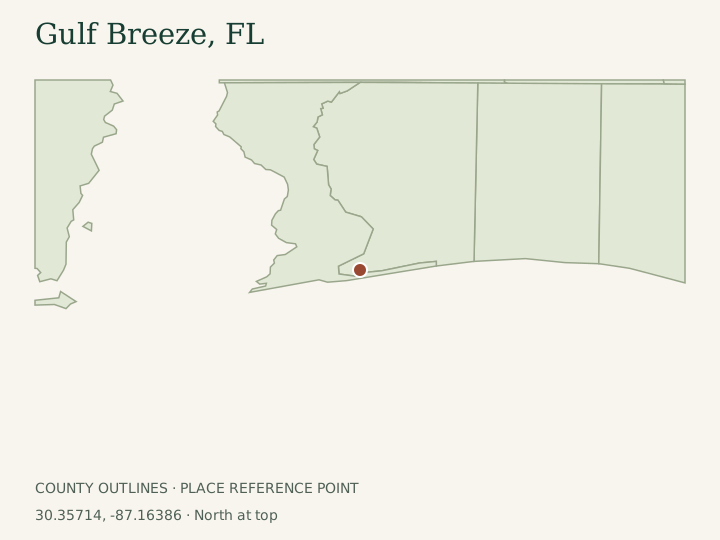
Start with city limits and the tree location
This guide concerns the City of Gulf Breeze in Santa Rosa County. Provide the parcel address and a marked tree location when asking about review. A company advertising across the Gulf Breeze area may work in several jurisdictions; its service-area description does not establish your property’s authority.
The municipal tree-removal page describes protected trees using species and trunk diameter, with exceptions. Ask the city to classify the actual tree rather than estimating eligibility from canopy height. Include whether it stands on private land, a right-of-way or another owner’s parcel. Access from your driveway does not by itself authorize work beyond the lot.
Separate normal care from removal
For clearance, begin with the conflict: a branch over a roof, access obstruction or damaged part of a retained canopy. Ask what selective work would meet the objective and which branches should remain. A broad request to open up the entire tree can produce proposals with very different effects.
The city distinguishes ordinary maintenance pruning from work that mutilates, kills or effectively removes a tree. If removal is the actual objective, use the removal review route. For a tree whose condition is uncertain, request an assessment before accepting an irreversible solution. Do not describe a healthy tree as dangerous simply because it stands in a proposed building area.
Use current evidence for a proposed exception
The municipal page describes application review and possible grounds for removal. It also quotes an older version of Florida’s residential-tree statute. Consult the current Florida text before relying on that exemption; it has specific property, assessment and risk conditions. A contractor’s verbal assurance is not the same as the required documentation.
A storm does not automatically cancel local procedures. The city’s page describes the possibility of a temporary city-manager waiver during a declared emergency. Ask which current action applies, its scope and any required records. Keep the emergency response distinct from later optional cutting. Public safety may require immediate routing to emergency responders or the utility before a private work order is discussed.
Choose between a cart, a residential drop-off and hauling
The ordinary solid-waste page identifies Wednesday yard-waste collection in the issued cart. That is a small-material collection system, not a whole-tree hauling service. The transfer station page identifies a residential route for larger woody material, including trunks and stumps.
That same station page warns against directing contractors there, while displaying a commercial rate. Its seasonal hours also vary from other city calendars. Treat those as issues to confirm with Public Works, not as grounds to choose whichever statement suits the bid. Ask about the actual load, who is transporting it and the current opening arrangements before removing hauling from the contract.
Give bidders a decision-ready project note
Consider a resident who wants one tree assessed and expects to use the transfer station for cleanup. The first question is whether the tree can stay; the second is whether the proposed material and transporter qualify for the residential route. Resolve both before comparing cutting-only and fully hauled prices.
List equipment access, surfaces to protect, permission needed from neighbors, stump preference and the desired condition of the finished area. Request separate entries for assessment, authorized cutting, hauling, stump work and restoration. Have the contractor identify any disposal assumption. A written alternative for a rejected load prevents the owner being left with a curbside pile and an unexpected second contract.
Questions about this work
Does ordinary maintenance require the same process as removal?
The city page distinguishes routine pruning from effective destruction. Confirm the actual scope when heavy canopy work or protected trees are involved.
Can my landscaper use the residential transfer station?
Do not assume so. The page warns against contractor use despite showing a contractor rate; ask Public Works about the actual transporter and load.
Is the old danger-letter summary sufficient?
Use current state requirements and the actual signed assessment. Older municipal quotations do not replace the operative statute.
Nearby field guides
Great-circle distances between GeoNames place points, not driving distances or service coverage. Showing up to eight nearest published guides.
Preparing your local map…
The map loads automatically as you approach it. City links work without JavaScript.
Distances between GeoNames place points, not driving distances or service coverage. US Census January 2025 state/county boundaries, not municipal limits. Points: GeoNames, CC BY 4.0. Map interface: Leaflet.