
Tree services in Greenville, SC
Plan removal, tree trimming or fallen-tree cleanup using the local checks below. For service scope, start with tree removal, trimming and pruning or storm damage work.
Tree services in Greenville



South Carolina local tree-work decisions
In Greenville, start by identifying the tree’s owner and the local decision you need: assessment, pruning, removal or disposal. Greenville’s zoning-permit list identifies a Tree Disturbance Form for tree removal within formal City limits.
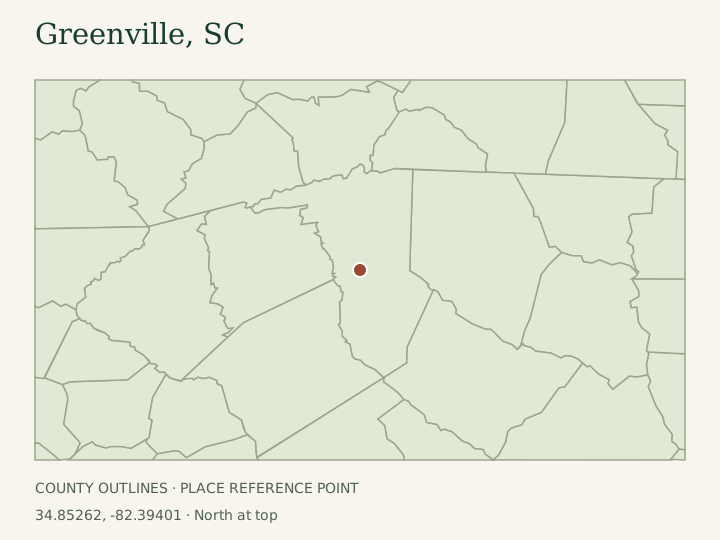
Establish the local authority and project conditions
Greenville’s zoning-permit list identifies a Tree Disturbance Form for tree removal within formal City limits. Its e-forms page describes that application in terms of significant and heritage trees, while the landscaping page explains an ordinance change tied to property purchases after June 30, 2021. These summaries are not interchangeable tests. Give Planning & Development the parcel, purchase history, species, tree size and any approved landscape plan, and ask which current provisions apply. Do this before setting an ordinary removal date. Keep the response and any mitigation conditions with the marked-tree schedule so each bidder prices the same authorized result. A Greenville mailing address alone does not establish municipal jurisdiction. See the source instructions for the stated scope.
Separate private care from public-tree work
The City’s Landscaping & Trees page expressly warns against excessive pruning and topping and points to section 19-5.2.2.E of its Development Code. It describes replacement planting as a consequence of noncompliant work. A proposal to reduce every tree to one height therefore needs scrutiny before acceptance. Ask the assessor to state the clearance objective, species and canopy to be retained, and obtain City clarification where required landscaping is involved. The City’s page is a local compliance source, not an inspection of your tree. Work near public planting or electric equipment also needs the relevant owner or operator’s involvement; a private estimate cannot settle those boundaries. See the source instructions for the stated scope.
Choose an eligible destination before leaving wood
Greenville’s current Yard Waste page allows eligible City Solid Waste customers to place loose branches at the curb, with limbs no longer than six feet and no more than six inches in diameter. Leaves and grass belong in a separate loose pile; bags, dirt and mulch are not collected through that arrangement. The page limits service to City customers. It does not establish that every paid removal load or large trunk is eligible. Ask Solid Waste about the actual source and volume before accepting a curb-only cleanup line. For commercial transport to a Greenville County facility, the County’s Disposal Services page directs all commercial haulers to Twin Chimneys, rather than residential centers. Confirm the wood category and charge there before dispatch. See the source instructions for the stated scope.
Keep routine arrangements distinct from storm response
A storm does not turn Greenville’s ordinary yard route into a purchased private removal service. The current City page says eligible yard waste is collected on the normal collection day without a scheduling call, but this presumes an eligible customer and prepared material. Report an immediate threat through emergency and utility channels rather than waiting for that route. After the site is safe to assess, separate damaged standing trees, detached branches and mixed building debris. Ask Public Works about any current event instruction; an older Helene project or a river cleanup announcement is not proof that a new private-yard load will be collected. Keep sidewalks and drainage clear when arranging any approved staging. See the source instructions for the stated scope.
Confirm the receiving route for the actual load
Greenville County lists Blackberry Valley Residential Waste and Recycling Center at 409 Blackberry Valley Road for the west/downtown area. The County requires proof of residence and limits residential-center quantities; businesses must use Twin Chimneys. Its pages express the residential quantity limit in different ways, including per vehicle and per person. Confirm the applicable load rule with the operator. County recycling guidance also sets branch dimensions, so do not infer acceptance of a large trunk or stump from the words “yard debris.” Select the receiving route before deciding whether an owner or paid hauler transports the material. See the receiving operator’s instructions.
Give each bidder the same work brief
Label the trees and describe the unresolved concern before asking for prices. An assessment may support retention, pruning or removal; it is separate from municipal permission. Give each bidder the same access route, retained planting and desired finish. Request an itemized written scope for cutting, loading, transport, stump work and restoration, with exclusions and change approval stated. Verify insurance and relevant qualifications directly. If the local authority or receiving decision remains open, keep that dependency visible rather than comparing two estimates that assume different outcomes.
A Greenville work-brief example
Use this as a planning example, not a report of a completed job. A homeowner with a Greenville mailing address wants one canopy thinned and another tree removed. First establish City limits and the Solid Waste account. Send the same labeled tree list to Planning and the assessor, including purchase history where relevant. Treat the pruning objective separately from removal authorization, and require a destination for wood too large for the six-inch curb limit. The accepted brief should state whether chips remain and whether stump work is included.
Choose the guide for the property’s municipality
Check municipal boundaries before carrying Greenville instructions into Mauldin. Greenville’s City-customer page calls for loose yard piles, while Mauldin publishes a much smaller routine limb allowance and its own contractor exclusion. For a Mauldin property, continue with Mauldin tree-work overview. Each municipality decides its own requirements and collection eligibility; these links do not imply shared rules or provider coverage.
Before accepting the scope
- Authority: City of Greenville Planning & Development / Public Works: identify the tree, project and applicable decision.
- Scope: List assessment, pruning or removal separately from hauling and ground work.
- Access: Agree protection for surfaces, retained roots and shared routes.
- Material: Confirm the actual receiver, load category, transporter and collection date.
Questions about this work
Which local question should I resolve first?
Identify the property and the tree’s public or private status, then ask City of Greenville Planning & Development / Public Works about the relevant local process. Owner permission, a professional recommendation and an authority decision are separate.
Can I leave all removal material for routine collection?
Use the specific local material category and account eligibility. Greenville’s current Yard Waste page allows eligible City Solid Waste customers to place loose branches at the curb, with limbs no longer than six feet and no more than six inches in diameter. Ask the operator about large wood, stumps, contractor loads and the intended date before accepting an estimate that leaves them.
How do I compare companies without a local price claim?
Give bidders the same tree labels, authority information, access constraints and desired finish. Request itemized written scopes and verify insurance and required qualifications directly. The comparison should resolve differences in work and cleanup before comparing totals.
Sources and scope
Checked: November 4, 2026. City instructions retain their municipal, development or collection scope. Clemson University Extension is a separate regional technical source. Applicability qualifications, dated storm notices and receiving conflicts are identified above. Regional tree-care guidance, utility work and receiving instructions retain their own scopes. Individual parcel permission, load admission and provider coverage still need project-specific confirmation. Dated documents are identified in the text; confirm current requirements for the actual property and load. Work-brief examples are hypothetical planning aids. No site inspection, individual contractor verification or receiver admission has been completed for your project.
- Greenville: Zoning Permits
- Greenville: Building Permit Applications E-Forms
- Greenville: Landscaping & Trees
- Greenville: Yard Waste
- Greenville County: Disposal Services & Fees
- Greenville County: Residential Waste & Recycling Centers
- Greenville County: What Can I Recycle
- Clemson University Extension: Principles & Practices for Pruning Trees, HGIC 1003
- Duke Energy: If Your Equipment Contacts a Power Line
Nearby field guides
Great-circle distances between GeoNames place points, not driving distances or service coverage. Showing up to eight nearest published guides.
Preparing your local map…
The map loads automatically as you approach it. City links work without JavaScript.
Distances between GeoNames place points, not driving distances or service coverage. US Census January 2025 state/county boundaries, not municipal limits. Points: GeoNames, CC BY 4.0. Map interface: Leaflet.