
Tree services in Westerly, RI
Plan removal, tree trimming or fallen-tree cleanup using the local checks below. For service scope, start with tree removal, trimming and pruning or storm damage work.
Tree services in Westerly



Rhode Island tree-work decisions
In Westerly, identify who controls the tree before choosing a crew, then decide how the cut material will leave. A road-edge concern belongs with the Town’s public-tree authorities; a private project needs its own assessment and written scope. Brush, compost and stumps have different receiving outcomes.
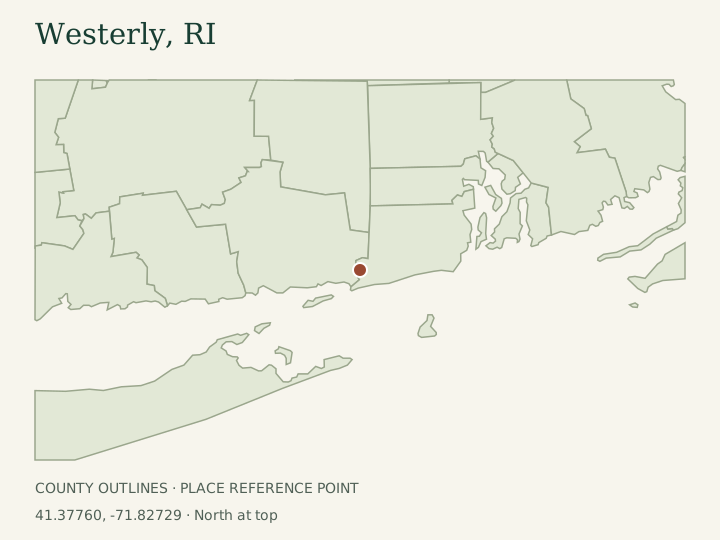
Start with the tree location and the decision
A tree apparently inside a lawn can still need a public-right-of-way check. Give the Town a street address, the nearest intersection and photographs taken from a safe position. Ask whether the concern is a municipal tree, a state-road matter or a private tree. The Westerly charter assigns highway and waste functions to Public Works and provides for a Council-appointed Tree Warden under the Manager. It does not establish a universal private-tree removal permit in this guide.
For a private tree, describe the problem rather than prescribing the answer. A branch rubbing a roof, a recent lean and a tree occupying a building footprint are different requests. Ask an arborist whether assessment, selective pruning, monitoring or removal addresses that particular problem. The location record and the recommended intervention should travel together when you request estimates.
Verify who will perform the proposed work
Rhode Island DEM’s licensing page distinguishes standard arboriculture from limited utility work. A limited utility license is not a general tree-care credential. Ask which person will supervise your job and verify that person’s current license category rather than relying on a business name or a certification logo. Check the actual proposed subcontractors and insurance documentation separately.
A useful estimate identifies each tree, the agreed outcome and the equipment route. Have the company explain how it will protect remaining trees, pavement, fences and planted beds. Permission to remove a tree does not provide access through a neighbor’s land. Resolve any off-property staging before comparing prices; otherwise one proposal may assume access that another has correctly excluded.
Match the cleanup plan to Westerly’s receiving rules
The Town’s Area 5 instructions separate brush from compost and exclude stumps. Brush goes through weighing and the designated receiving process. Request separate handling for small vegetative material, heavier wood and the stump; “yard waste removed” is too broad to explain which destination has accepted each category.
The transfer-station page describes residential/property-owner stickers and separate visitor passes. These credentials are not blanket permission for a hired company’s loads. Ask the receiver about the hauler, vehicle and exact material before including a Town drop-off in your contract. Current construction notices also affect the visit: on October 24, 2026 the page announces work starting October 19 and possible traffic or vehicle-access changes. Check the live notice before setting a delivery date.
Keep utility restoration separate from private cleanup
For wires down or a tree touching electrical equipment, stay clear and report the hazard to emergency services and the actual line operator. Do not approach to identify the wire or pull branches away. A private tree estimate cannot authorize a crew to enter an electrically unsafe area.
Where Rhode Island Energy operates the lines, its responsibility guidance separates restoration clearance from cleanup of storm debris away from those lines. After the immediate hazard is released, commission the remaining assessment and hauling explicitly. For a property in the neighboring town, consult the Charlestown tree-work guide: Charlestown has an express public-tree permit process, and Westerly’s station credentials do not establish access to Charlestown’s residential center.
Build a brief that survives a change of crew
Use one marked photograph or site sketch for all bidders. Number the trees, identify retained plants, state the access width and list any known underground or overhead conflicts. Ask each bidder to price the same base work and show alternatives separately. A removal proposal should state whether the stump remains, is ground or is excavated, and who keeps or removes the resulting grindings.
For pruning, describe the clearance or branch-management objective and the crown that should remain. For storm recovery, distinguish immediate stabilization from later tree decisions and site restoration. Before accepting, read the completion condition aloud: which wood leaves, what surface is restored, who obtains approvals and what happens if a load is rejected. These details are more useful than an undefined promise to leave the yard clean.
Questions about this work
Does every Westerly tree need Town removal permission?
This guide does not establish that. Confirm public-right-of-way status, applicable site approvals and environmental constraints for the actual address. The Town charter describes public responsibilities; it does not settle every private parcel or authorize cutting a neighbor’s tree.
Can the transfer station take the stump with the branches?
The published Area 5 page excludes stumps. Ask for a separate accepted route or a clearly specified on-site stump treatment. A brush destination should not be assumed to accept a soil-covered root mass.
How do I compare an assessment with a removal estimate?
Ask what the assessment delivers and whether it includes a written recommendation. A removal price describes an operation; it does not by itself explain why retention or pruning was rejected. Compare those decisions before comparing the cutting totals.
Nearby field guides
Great-circle distances between GeoNames place points, not driving distances or service coverage. Showing up to eight nearest published guides.
Preparing your local map…
The map loads automatically as you approach it. City links work without JavaScript.
Distances between GeoNames place points, not driving distances or service coverage. US Census January 2025 state/county boundaries, not municipal limits. Points: GeoNames, CC BY 4.0. Map interface: Leaflet.