
Tree services in Wilmington, DE
Plan removal, tree trimming or fallen-tree cleanup using the local checks below. For service scope, start with tree removal, trimming and pruning or storm damage work.
Tree services in Wilmington



Delaware tree-work decisions
In Wilmington, first distinguish a private yard tree from a street tree. The city uses a street-tree permit, while its limited private-tree assistance program has separate eligibility and approval. Plan the actual tree work and the wood removal together: routine yard-waste collection does not establish acceptance of a complete removal or a contractor's load.
Establish whose tree you are discussing
A tree beside your sidewalk is not automatically yours to alter. Send the address, trunk location, and photographs to Public Works if ownership or the right-of-way is unclear. Identify any roots or equipment routes that extend into a street-tree protection area. Permission to work on a private tree does not settle impacts on an adjacent public tree.
The street-tree permit instructions distinguish that program from private-property trees. Keep that distinction in your inquiry and in each estimate. Ask the city to identify the relevant tree before a contractor schedules cutting, excavation, or equipment staging near it.
Match the permit to the proposed impact
Wilmington requires permits for street-tree removal and planting, and for pruning street-tree branches larger than two inches in diameter. Root pruning and disturbance or compaction within the protection zone also require a permit. A small visible canopy job can therefore involve a separate concern below ground.
Describe the full operation: branches to be removed, any digging, where equipment will stand, and how wood will leave. The city process includes inspection and a written decision. Build the schedule around the actual decision rather than a bidder's assumption that a submitted request will be approved.
Choose assessment, pruning, or removal
A branch rubbing a structure, an apparently declining crown, and a tree already lying on a fence call for different briefs. Begin with the observed problem. Ask an assessor what can reasonably be retained, what uncertainty remains, and whether the work can be staged. Avoid authorizing removal solely because it is the first option quoted.
For pruning, identify the clearance or structural objective and the canopy to retain. For removal, identify the exact tree and stump endpoint. Storm work requires an initial hazard and utility review before normal access planning. The service guides below take these decisions further.
Check assistance before committing to paid work
The city's private-tree pilot describes help for qualifying low-income owner-occupants, subject to inspection, necessary work, approval, and limited funds. It is a conditional program, not a citywide promise to remove private trees. Ask the program about current applications and funding before making a financial commitment that assumes reimbursement.
The city also separates branches touching wires from ordinary program work: the responsible wire organization must handle that issue. Determine whether the concern involves electric or communications equipment. An assistance application does not make the tree safe or authorize a homeowner to move an entangled branch.
Arrange the material route before cutting
The collection page places yard waste on recycling days and requires separation from trash. It does not, by itself, establish the permitted dimensions, volume, or contractor origin of a whole-tree load. Ask Wilmington 311 about your proposed material before leaving it for collection.
For larger wood, DNREC's facility directory lists Cherry Island composting and mulching in Wilmington, including logs and stumps, with fees. Verify current acceptance, preparation, vehicle access, and origin requirements directly before hauling. A directory listing is useful planning evidence, not a reservation for your contractor's truck.
Compare the completed outcome
Use one written project description for every bidder. Include authority confirmation, access, protection for retained trees and paving, cutting scope, stump choices, hauling, and cleanup. Ask who handles each unresolved approval and whether the date depends on it. Compare totals only after the inclusions are clear.
An illustrative brief might request assessment of one private tree, a removal alternative if justified, separate stump pricing, and removal of all wood to a confirmed receiver. If a lower estimate leaves logs or grindings, calculate the remaining work before choosing. Use the shared budget tool on the removal guide as a national planning reference, not a Wilmington quote.
Questions about this work
Does a private tree need the street-tree permit?
The city's street-tree page says permits are not required for private-property trees. Confirm the trunk location and any impact on a neighboring street tree; other property agreements or project conditions require their own review.
Will the city pay for my work?
The assistance pilot has income, ownership, inspection, funding, and approval conditions. Contact the program before relying on assistance. This guide does not determine eligibility or confirm available funding.
Can all the cut wood go out on recycling day?
The routine collection notice does not establish whole-tree acceptance. Confirm the actual material and origin with the city, or include hauling to an accepting facility in the contractor's written scope.
Nearby field guides
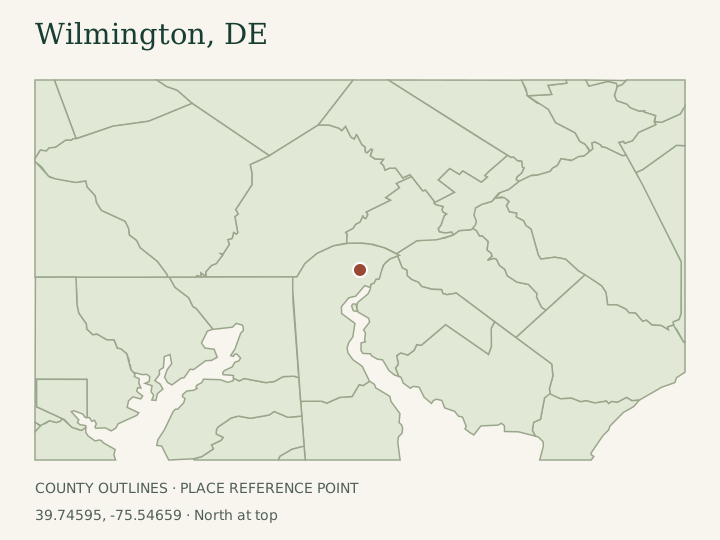
Great-circle distances between GeoNames place points, not driving distances or service coverage. Showing up to eight nearest published guides.
Preparing your local map…
The map loads automatically as you approach it. City links work without JavaScript.
Distances between GeoNames place points, not driving distances or service coverage. US Census January 2025 state/county boundaries, not municipal limits. Points: GeoNames, CC BY 4.0. Map interface: Leaflet.