
Tree services in Oregon City, OR
Plan removal, tree trimming or fallen-tree cleanup using the local checks below. For service scope, start with tree removal, trimming and pruning or storm damage work.
Tree services in Oregon City



Oregon local tree-work decisions
In Oregon City, start by identifying the tree’s owner and the local decision you need: assessment, pruning, removal or disposal. Oregon City's permit guide requires removal review for street trees, nonresidential zoning and specified protected situations even on residential land.
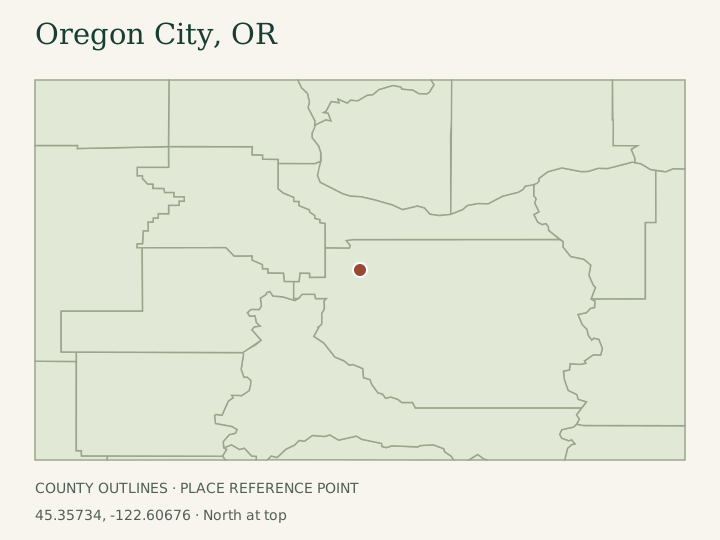
Establish the local authority and project conditions
Oregon City's permit guide requires removal review for street trees, nonresidential zoning and specified protected situations even on residential land. Its general private-residential exception excludes multifamily and mixed-use cases and does not override natural-resource buffers, geological hazards, approved landscape plans or recorded protections. Identify zoning and those constraints before deciding no permit is needed. Ask Planning which application, addendum and replacement outcome apply to the actual tree. A street tree always needs removal permission under the guide. Keep the boundary and tree label in the bid, including any public-space access and root protection. An ordinary house address does not establish the zoning classification or remove recorded landscape obligations. See the source instructions for the stated scope.
Separate private care from public-tree work
Oregon City's guide says normal pruning and maintenance, including pruning a street tree abutting the property, do not need the removal permit. It also prohibits topping and describes that practice as indiscriminate removal of more than half the canopy. That is a local distinction from nearby cities that permit street-tree pruning, not a reason to seek the maximum canopy reduction. Have the assessor identify species, objective, retained form and timing. Ask Planning about unusually extensive work or a protected site and coordinate utility-line concerns with the actual operator. Describe access and branch cleanup in writing. A contract for routine pruning should not silently include removal of the street tree or destructive root changes. See the source instructions for the stated scope.
Choose an eligible destination before leaving wood
Metro South is at 2001 Washington Street in Oregon City and lists separate garbage, clean wood and sorted yard-debris categories. Its clean-yard-debris category excludes stumps, sod, dirt, rocks and other contamination. Confirm the actual pieces and commercial load before using that category in a removal estimate; dimensional lumber is not the same category as fresh branches. The operator and Clackamas County directory publish different general-public hours, so obtain current operator confirmation rather than promising the directory's longer evening window. Facility and hazardous-waste hours also differ. Include transport, load sorting, stump outcome and restoration separately. A nearby facility makes planning possible but does not establish admission of every load or permission to remove a protected tree. See the source instructions for the stated scope.
Keep routine arrangements distinct from storm response
Oregon City's guide provides separate addenda for dead, diseased and hazardous street trees and continues to identify street-tree removal as a permitted activity. Damage therefore needs a case-specific conversation with Planning rather than an assumed blanket exemption. Keep clear of unstable trees and wires, use emergency responders for immediate threats and the serving utility for line involvement, and report the precise public obstruction to the responsible authority. Preserve safe evidence for the applicable review. After assessment, distinguish corrective care of retained trees from removal and detached-debris hauling. Metro South's routine categories remain separate from any incident-specific collection; do not leave private logs in public space on the assumption that road clearance includes final disposal. See the source instructions for the stated scope.
Choose the right request and compare written scopes
If the condition of a tree is undecided, request an assessment before buying a predetermined removal. Identify whether the next step is retention advice, pruning, approved removal or hauling material that is already safely detached. Give bidders the same tree labels and access information, then request written inclusions for cutting, material transport, stump work and restoration. Confirm insurance and any required credentials directly. Keep the responsible authority’s instructions with the accepted scope, and record who addresses each excluded item. The linked quote-comparison guide develops this purchase checklist; the local sections here establish the municipal decisions that must come first.
A Oregon City work-brief example
Use this as a planning example, not a report of a completed job. An Oregon City owner wants a private tree removed near a steep slope. Check the geological-hazard overlay and any approved landscape plan before using the residential exception. Compare assessment and authorized removal, then confirm Metro’s categories for branches, trunk wood and excluded stump material.
Use the guide for the actual municipality
For a property in Lake Oswego, use the Lake Oswego tree-work overview to check that jurisdiction before transferring this plan. Lake Oswego's storm-recovery page distinguishes a tree already on the ground from a standing damaged or hazardous tree. The location of the property determines the applicable procedure; these neighboring guides do not establish shared rules or provider coverage.
Before accepting the scope
- Authority: Oregon City Planning and Public Works and Metro South: identify the tree, project and applicable decision.
- Scope: List assessment, pruning or removal separately from hauling and ground work.
- Access: Agree protection for surfaces, retained roots and shared routes.
- Material: Confirm the actual receiver, load category, transporter and collection date.
Questions about this work
Which local question should I resolve first?
Identify the property and the tree’s public or private status, then ask Oregon City Planning and Public Works and Metro South about the relevant local process. Owner permission, a professional recommendation and an authority decision are separate.
Can I leave all removal material for routine collection?
Use the specific local material category and account eligibility. Metro South is at 2001 Washington Street in Oregon City and lists separate garbage, clean wood and sorted yard-debris categories. Ask the operator about large wood, stumps, contractor loads and the intended date before accepting an estimate that leaves them.
How do I compare companies without a local price claim?
Give bidders the same tree labels, authority information, access constraints and desired finish. Request itemized written scopes and verify insurance and required qualifications directly. The comparison should resolve differences in work and cleanup before comparing totals.
Sources and scope
Checked: October 28, 2026. Procedures follow the named municipality. State guidance, county receiving information and operator instructions retain their stated geography and eligibility. Dated documents are identified in the text; confirm current requirements for the actual property and load. Work-brief examples are hypothetical planning aids. No site inspection, individual contractor verification or receiver admission has been completed for your project.
Nearby field guides
Great-circle distances between GeoNames place points, not driving distances or service coverage. Showing up to eight nearest published guides.
Preparing your local map…
The map loads automatically as you approach it. City links work without JavaScript.
Distances between GeoNames place points, not driving distances or service coverage. US Census January 2025 state/county boundaries, not municipal limits. Points: GeoNames, CC BY 4.0. Map interface: Leaflet.