
Tree services in Blue Springs, MO
Plan removal, tree trimming or fallen-tree cleanup using the local checks below. For service scope, start with tree removal, trimming and pruning or storm damage work.
Tree services in Blue Springs



Missouri local tree-work decisions
In Blue Springs, start by identifying the tree’s owner and the local decision you need: assessment, pruning, removal or disposal. Blue Springs’ current Property Maintenance Code page assigns compliance to owners, operators and occupants and directs questions to Codes Administration.
Establish the local authority and project conditions
Blue Springs’ current Property Maintenance Code page assigns compliance to owners, operators and occupants and directs questions to Codes Administration. For an actual notice involving a tree, ask the officer to identify the required remedy and affected tree before obtaining bids. Where a trunk or work access is in a public right-of-way, use Public Works Operations to establish responsibility. The general code overview does not settle every tree-removal permission, and the presence of a disposal directory is not an exemption. Include any development, utility or ownership restriction in the project information given to the assessor. The current Codes tips also require removal and proper disposal of brush piles; an unfinished pile is not a complete cleanup outcome. See the source instructions for the stated scope.
Separate private care from public-tree work
Blue Springs’ current Codes Administration tips state that limbs over the sidewalk or street must be trimmed to provide at least eight feet of clearance. Use the actual location and ask Codes/Public Works to confirm which authorization applies before ordering public-tree work. Describe the pedestrian or visibility issue to the assessor and request a retained-canopy objective, rather than ordering a general cutback. Where utility facilities are involved, coordinate with the serving operator first. The City also requires proper disposal of brush piles, so agree the branch destination and pickup arrangement in the pruning scope. See the source instructions for the stated scope.
Choose an eligible destination before leaving wood
Blue Springs’ current Residential Disposal page lists yard-waste receiving options at Eastern Jackson County’s Pink Hill Road facility, Summit Transfer in Lee’s Summit and Missouri Organic Recycling in Kansas City. It specifically tells readers to contact the facility about directions, charges, hours and material acceptance. Those are alternative operators with separate rules, not three interchangeable City free-drop benefits. Choose a receiver that accepts the actual branch, trunk or stump category and the intended transporter. A contractor who offers curbside-only cleanup should identify how the remainder will reach an accepted destination. See the source instructions for the stated scope.
Keep routine arrangements distinct from storm response
After damage, Blue Springs’ current directory provides a Public Works Operations route, while its police email is marked as not monitored continuously. Use immediate emergency and utility reporting for dangerous conditions; do not rely on an unattended message to make a route safe. The checked residential-disposal directory is a routine referral, not evidence that a special storm collection is active. Keep a public obstruction report, private standing-tree assessment and transport to an independently confirmed receiver as separate items. Request written changes if the assessment discovers damage beyond the original hauling scope. See the source instructions for the stated scope.
Choose the right request and compare written scopes
If the condition of a tree is undecided, request an assessment before buying a predetermined removal. Identify whether the next step is retention advice, pruning, approved removal or hauling material that is already safely detached. Give bidders the same tree labels and access information, then request written inclusions for cutting, material transport, stump work and restoration. Confirm insurance and any required credentials directly. Keep the responsible authority’s instructions with the accepted scope, and record who addresses each excluded item. The linked quote-comparison guide develops this purchase checklist; the local sections here establish the municipal decisions that must come first.
A Blue Springs work-brief example
Use this as a planning example, not a report of a completed job. An owner has a private low branch over a sidewalk and a heavy trunk left after earlier work. Ask Codes/Public Works which current instruction governs the clearance, then purchase a pruning result rather than an unspecified cutback. Ask the cleanup bidder to name a receiver and verify the heavy-wood category. The current City tips allow curbside staging only in the specified collection window, from 6 p.m. the preceding evening through 10 p.m. on collection day; confirm the actual collection before leaving material there.
Use the guide for the actual municipality
For a property in Independence, use the Independence tree-work overview to check that jurisdiction before transferring this plan. In Independence, first distinguish a private tree from a problem affecting the electric system or public access. The location of the property determines the applicable procedure; these neighboring guides do not establish shared rules or provider coverage.
Before accepting the scope
- Authority: Blue Springs Codes Administration / Public Works Operations: identify the tree, project and applicable decision.
- Scope: List assessment, pruning or removal separately from hauling and ground work.
- Access: Agree protection for surfaces, retained roots and shared routes.
- Material: Confirm the actual receiver, load category, transporter and collection date.
Questions about this work
Which local question should I resolve first?
Identify the property and the tree’s public or private status, then ask Blue Springs Codes Administration / Public Works Operations about the relevant local process. Owner permission, a professional recommendation and an authority decision are separate.
Can I leave all removal material for routine collection?
Use the specific local material category and account eligibility. Blue Springs’ current Residential Disposal page lists yard-waste receiving options at Eastern Jackson County’s Pink Hill Road facility, Summit Transfer in Lee’s Summit and Missouri Organic Recycling in Kansas City. Ask the operator about large wood, stumps, contractor loads and the intended date before accepting an estimate that leaves them.
How do I compare companies without a local price claim?
Give bidders the same tree labels, authority information, access constraints and desired finish. Request itemized written scopes and verify insurance and required qualifications directly. The comparison should resolve differences in work and cleanup before comparing totals.
Sources and scope
Checked: October 25, 2026. Procedures follow the named municipality. State guidance, county receiving information and operator instructions retain their stated geography and eligibility. Dated documents are identified in the text; confirm current requirements for the actual property and load. Work-brief examples are hypothetical planning aids. No site inspection, individual contractor verification or receiver admission has been completed for your project.
- Blue Springs Codes Administration / Public Works Operations — tree responsibility
- Blue Springs Codes Administration / Public Works Operations — material arrangements
- Blue Springs Codes Administration — current tree clearance, brush and staging tips
- Blue Springs Codes Administration / Public Works Operations — reporting and event instructions
Nearby field guides
Great-circle distances between GeoNames place points, not driving distances or service coverage. Showing up to eight nearest published guides.
Preparing your local map…
The map loads automatically as you approach it. City links work without JavaScript.
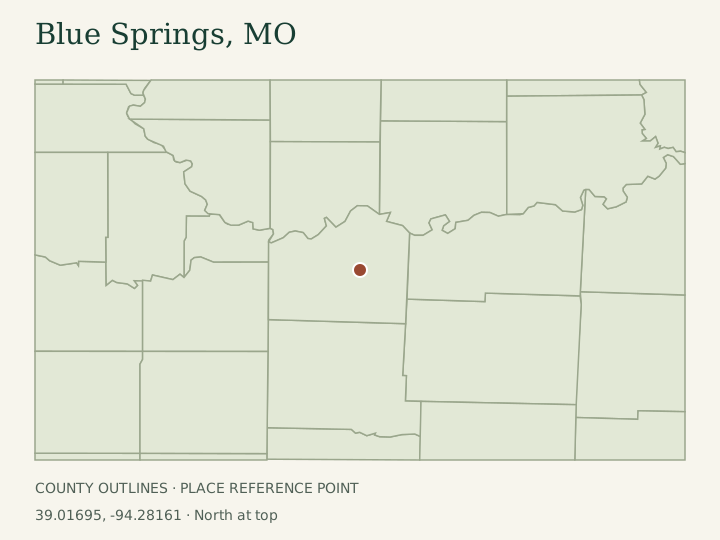
Distances between GeoNames place points, not driving distances or service coverage. US Census January 2025 state/county boundaries, not municipal limits. Points: GeoNames, CC BY 4.0. Map interface: Leaflet.