
Tree services in Michigan City, IN
Plan removal, tree trimming or fallen-tree cleanup using the local checks below. For service scope, start with tree removal, trimming and pruning or storm damage work.
Tree services in Michigan City



Indiana tree-work decisions
Michigan City is in Indiana, and its tree-work rules follow the City Forester rather than Michigan state guidance. Check the hired contractor’s City license, obtain the applicable public-tree permission, and distinguish household compost pickup from tree-removal hauling.
Use the Forester to identify the right tree request
Michigan City’s City Forestry page provides a request route for inspections, removals and pruning. The form distinguishes privately owned trees from city-maintained trees. Use the actual address and tree position when submitting it; requesting assistance is not the same as receiving authorization or confirmation that the City will pay for the work.
The page requires a tree permit for removal, pruning or planting on city-owned rights-of-way. If the trunk sits near the street or sidewalk, ask the Forester to determine the applicable process before making a private cutting arrangement. This rule should not be expanded into a claim that every backyard tree has the same permit requirement.
Verify the hired business before comparing its proposal
The Forestry page says hired contractors need a Michigan City license for both public and private tree work. It links an application and a 2026 licensed-arborist list. Check the actual business with the City and ask for current insurance documents. A regional advertisement, an address in another town or the presence of a general professional credential does not replace that local check.
Then ask what service the tree needs. A thinning crown may call for assessment; a specific branch conflict may suit pruning; a tree whose condition warrants removal needs a removal scope. Ask the firm to explain its recommendation and alternatives. Do not let a disposal-only proposal make the decision about whether a standing tree can remain.
Establish who controls the affected street
Central Services explains that not every roadway within city limits is city-owned. Some belong to the state, county or a private entity and fall outside Street Department service. That distinction matters when arranging equipment access, reporting an obstruction or asking who can approve work near a public route.
Describe the exact location rather than assuming the department responsible for a nearby street controls yours. Keep any routing response and share it with the contractor. A municipal tree permit, approval to use a road or access agreement, and the owner’s tree-work contract address different issues; one should not be treated as a substitute for all the others.
Match household compost and hauling to their actual limits
The current Refuse page limits household compost collection to four lidded 32-gallon containers, each weighing less than 50 pounds, with no sod, dirt or nonorganic material. It publishes a season beginning in the first week of May and ending the week before Thanksgiving. Confirm current operations rather than taking that recurring summary as a guarantee for the day after a storm.
Those household container rules do not establish collection for a trunk, stump, root ball or a commercial tree-service load. Ask Central Services about woody-debris routing; its current page directs grass, brush and tree questions to Vector Control. A contractor planning to leave a large pile needs an actual confirmation of eligibility, not an old version of a refuse webpage.
For material requiring hauling, the County’s 724 Zigler Road compost page lists trees, branches and clean stumps, while excluding trash, landscaping timbers, fencing and railroad ties. Confirm the actual load, commercial-hauler eligibility, fees and current access with the receiver. An accepted category is not unconditional admission of every mixed truckload.
Keep species timing and electrical responsibility separate
Purdue Extension’s pruning guidance explains why timing depends on species and objective, including dormant structural review and flowering exceptions. Use it to ask the assessor why the proposed schedule fits the tree. Do not import Michigan’s calendar as a City rule merely because the municipality’s name contains Michigan.
For branches affecting lines, verify the electric operator at the address. NIPSCO’s tree guidance warns against touching downed or sagging wires and separates emergency power restoration from branch and debris cleanup. Even where the operator handles a system threat, private assessment, additional tree work and hauling may remain. Electrical clearance must precede ordinary work in the affected area.
Make the quote comparison useful
Give each firm the same brief: address, tree identity or location, objective, Forester response, access route, features to protect and desired finish. Ask for separate descriptions of assessment, pruning or removal, wood handling, stump work and repair. Require clear authorization before changes. The best comparison is between scopes you understand, not simply two totals with different unfinished work.
For properties elsewhere in the county, La Porte tree-work planning follows that City’s Engineering request process and explicit whole-tree collection exclusion. The comparison helps choose the right jurisdiction; shared county geography does not make the municipal rules interchangeable. Neither directory proves a contractor is available at your address.
As a practical example, a curbside tree with a broken crown requires more than a hauling price. Ask the Forester who controls it, verify the hired firm’s license, obtain an assessment of the remaining tree and define the accepted destination for what is cut. That sequence gives each quote a concrete outcome and avoids treating a household compost bin as the final removal plan.
Questions about this work
Is Michigan City governed by Michigan’s tree rules?
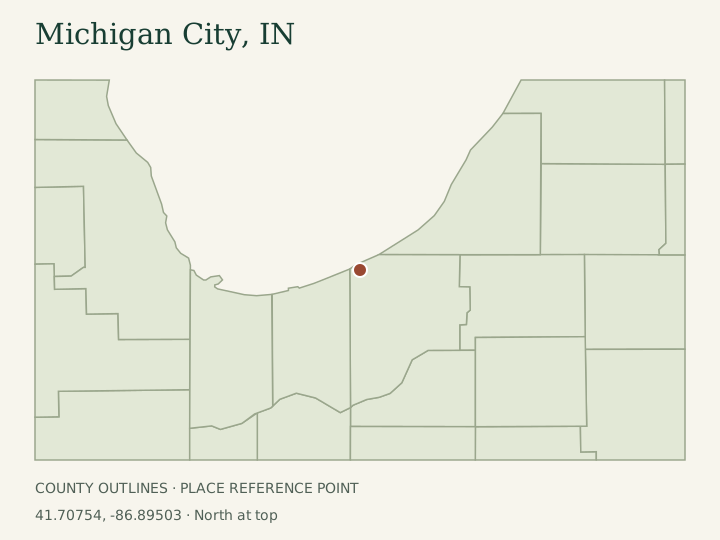
This guide concerns Michigan City, Indiana, in La Porte County. Use its City Forestry and Indiana sources. The Michigan state line is nearby, but that does not transfer another state’s guidance or a neighboring municipality’s approvals to the property.
Does a private-yard job need a City-licensed contractor?
The Forestry page expressly states that hired contractors need a City license for public and private tree work. Verify the current business with the City. The public-right-of-way permit is a separate location-specific requirement.
Can I use compost collection for a complete removal?
The current household collection rules describe limited containers, not unrestricted trunk or stump pickup. Confirm any qualifying material and arrange accepted hauling for the rest. Ask the County receiver about the actual load and hauler before relying on its listed material categories.
Nearby field guides
Great-circle distances between GeoNames place points, not driving distances or service coverage. Showing up to eight nearest published guides.
Preparing your local map…
The map loads automatically as you approach it. City links work without JavaScript.
Distances between GeoNames place points, not driving distances or service coverage. US Census January 2025 state/county boundaries, not municipal limits. Points: GeoNames, CC BY 4.0. Map interface: Leaflet.