
Tree services in New Buffalo, MI
Plan removal, tree trimming or fallen-tree cleanup using the local checks below. For service scope, start with tree removal, trimming and pruning or storm damage work.
Tree services in New Buffalo



Michigan tree-work decisions
For tree work in the City of New Buffalo, establish whether the tree occupies a right-of-way, decide whether it needs assessment, pruning or removal, and settle disposal before booking. Minor brush collection and a complete private-tree removal have different responsibilities.
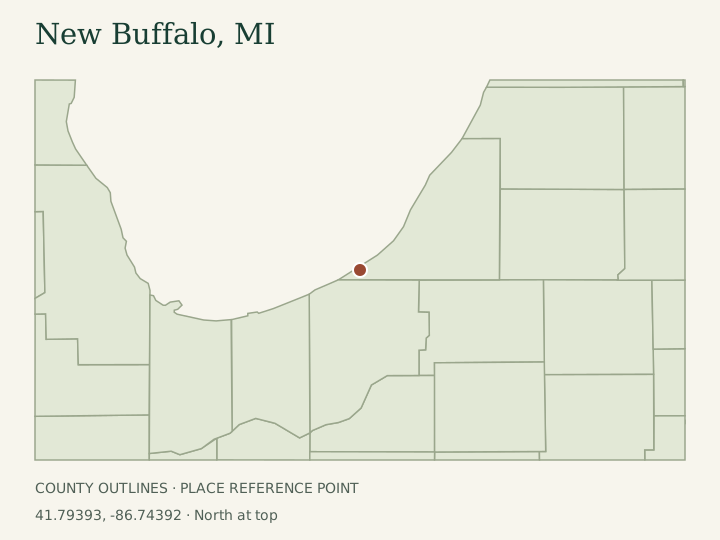
Start with the city boundary and the tree’s position
A New Buffalo mailing address alone does not identify the government responsible for the property. This overview follows the City of New Buffalo in Berrien County, Michigan. It does not extend the City’s policies into New Buffalo Township or neighboring lakefront communities. Give the City the actual address and a description of the tree’s location relative to the street and sidewalk when responsibility is uncertain.
Under section 18-6, planting or removing a tree or shrub in the right-of-way requires written permission from the City Manager or designated personnel. A contractor’s ability to reach the tree from your driveway does not resolve its ownership or permission. Ask for the applicable City decision before accepting a work date. The public-space provision does not establish that every backyard tree needs that same permit.
Choose an assessment before choosing a cutting scope
Describe the problem in ordinary terms: a hanging limb, a driveway conflict, a declining canopy or a tree leaning toward a public route. Those descriptions help the assessor understand the concern without pretending to diagnose the cause. Ask what can reasonably be retained, whether pruning would address the objective, and what findings support removal if it is proposed.
For private trees threatening an improved right-of-way, the same ordinance assigns responsibility to the owner and gives the City Manager or designee the final threat determination. Record any City instruction alongside the arborist’s recommendation. These are related but different decisions: one establishes the municipal requirement; the other explains the proposed tree work and its limits.
Match the material to the correct collection stream
Do not accept an estimate that simply says debris will be left for the City. New Buffalo’s September 2025 brush policy describes collection for storm branches and minor yard cleanup, while whole trees and stumps remain an owner or contractor responsibility. Its dated leaf calendar is for 2025; it must not be used as a 2026 appointment schedule.
The City’s regular solid-waste provisions define a separate curbside yard-waste stream with volume, length and packaging limits. A branch fitting one program’s dimensions does not establish that another program will accept it. Ask which service is being proposed, whether the quantity and origin qualify, and whether pickup is currently operating. For substantial private removals, section 18-6 expressly places debris disposal with the owner.
This matters when comparing tree-work planning in Three Oaks: that Village publishes its own container and bundled-branch arrangements. The two communities’ cleanup systems are useful to compare, but neither set of instructions transfers across the boundary. If a contractor plans a load combining work from several properties, require an identified receiving route rather than assuming a resident benefit covers it.
Plan timing around the species and the real risk
Michigan DNR’s April 2026 oak guidance advises avoiding oak pruning from April 15 through July 15 and favors winter work. That is state disease-prevention guidance, not evidence that a particular New Buffalo tree is infected. Have the species identified and explain whether the work is elective or responds to an immediate hazard. Do not postpone reporting a dangerous condition merely to reach a preferred pruning season.
If wires are involved, identify the operator serving the address. Indiana Michigan Power’s forestry FAQ distinguishes scheduled line work from emergency restoration and leaves storm-restoration debris cleanup with the property owner. Utility access work does not resolve municipal permission for additional elective cutting or provide a whole-yard restoration contract.
Build one brief that several firms can price
A useful request names the tree, the objective, any City response, access constraints and the intended finish. Include whether a gate must remain usable, where equipment may travel, which nearby plants should be protected and whether permission to cross a neighbor’s property has actually been obtained. Photographs taken from a safe position can clarify these points; they cannot replace an inspection.
Ask each firm to itemize assessment, pruning or removal, hauling, stump treatment and surface repair. Specify who handles any permit correspondence and how changes require your authorization. Michigan DNR’s removal resources recommend multiple arborist quotes and insurance checks; the agency’s urban forestry program does not provide direct or financial help for private removals. A state resource list therefore does not establish funding for your job.
For a practical example, a tree near a sidewalk with a declining upper crown presents three questions before a price comparison: who controls that location, whether selective work can retain it, and who takes the trunk and stump if removal is chosen. Resolve those questions in writing. Otherwise an inexpensive cutting proposal and a complete removal proposal describe different purchases.
Questions about this work
Does New Buffalo collect a whole tree from my yard?
Do not assume it. The private-removal ordinance places substantial debris disposal with the owner, and the brush policy separates minor cleanup from trees and stumps. Agree on hauling and an accepted receiver before the work creates a pile.
Does a tree near the sidewalk automatically belong to the City?
Its appearance does not settle ownership or right-of-way status. Ask the City to identify the applicable location and written-permission process. A mailing address, a fence or the fact that you mow the strip cannot substitute for that determination.
Which guide should I use after an ordinary inspection?
Choose the removal guide if the decision is to take the tree down, the pruning guide when the objective is retaining it with defined branch work, or the storm guide for damaged-tree assessment and staged recovery. Keep urgent wire or public-safety reporting ahead of contractor comparison.
Nearby field guides
Great-circle distances between GeoNames place points, not driving distances or service coverage. Showing up to eight nearest published guides.
Preparing your local map…
The map loads automatically as you approach it. City links work without JavaScript.
Distances between GeoNames place points, not driving distances or service coverage. US Census January 2025 state/county boundaries, not municipal limits. Points: GeoNames, CC BY 4.0. Map interface: Leaflet.