
Tree services in Conneaut, OH
Plan removal, tree trimming or fallen-tree cleanup using the local checks below. For service scope, start with tree removal, trimming and pruning or storm damage work.
Tree services in Conneaut



Ohio tree-work decisions
Conneaut tree work needs a clear distinction between permission, who pays and where the debris goes. City rules protect public and treelawn trees, while the property owner can still bear maintenance costs. The compost site distinguishes ordinary resident biomass, commercial loads and stumps, so confirm the actual hauling arrangement before accepting an estimate.
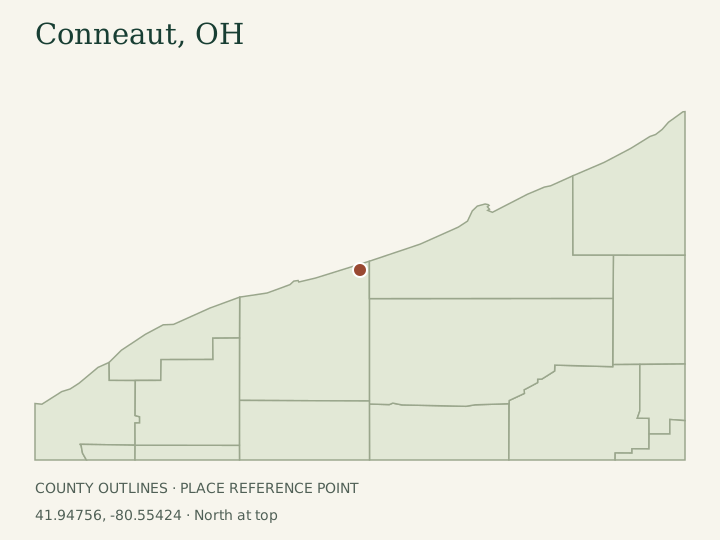
Confirm Conneaut, Ohio and the affected property
This guide follows the City of Conneaut in Ashtabula County, Ohio. It does not apply Pennsylvania's Conneaut Lake or township instructions. Give the City the street address and tree location, particularly where the trunk or branches occupy a treelawn or right-of-way. A postal name, mowing arrangement or contractor's regional service list cannot decide public-tree status.
Describe what you need before choosing a package: condition assessment, pruning of a specific conflict, removal of an identified tree or recovery after damage. Keep people away from unstable trees and suspended branches. For a downed or uncertain line, use FirstEnergy's safety route: stay clear, treat it as energized and call 911. Do not move wood to investigate which wire is involved.
Separate public-tree permission from cost responsibility
Conneaut section 917.08 restricts unauthorized cutting and damage to trees on treelawns, in parks and on other public places. Ask Public Service which approval and current City Tree Policy apply before hiring someone to alter the tree. Paying for the work does not by itself grant permission to do it.
Section 917.07 places maintenance/removal costs for private and treelawn trees on the property owner unless City Council provides otherwise. That default is different from a promise that the City will perform the work for free. Chapter 917 also lists commercial tree-business licensing and insurance requirements. Confirm applicability and the actual contractor's current authorization with the City; this guide has not verified a particular business.
Use the emergency provision within its real scope
Section 917.16 allows the Department to trim private limbs projecting into the right-of-way where they obstruct traffic-control devices or regulatory signs. It limits that action to the material needed to clear the obstruction or hazard. Do not convert this narrow Department power into a general homeowner right to remove any tree after a storm.
For a public obstruction, report the exact location and effect through the appropriate City or emergency route. Ask what remains for a private work order after initial access is restored. Utility restoration is another separate job: FirstEnergy says storm-tree and limb debris cleanup remains with property owners. Electrical release and a clean-looking road do not establish that every retained tree has been assessed.
Confirm the compost site's current operating conditions
Conneaut Public Works lists the compost/recycling site at 1200 Innovation Way, with Monday, Wednesday and Saturday opening subject to weather and staffing and closures on major holidays. Check current operation before arranging a loaded trip. An ordinary published schedule is not an event-specific extension or a reservation for a substantial tree-removal load.
The City lists residential biomass including limbs, grass, leaves and chips. Its ordinary City-resident exemption requires residency proof, with stumps treated separately. The same page says residential-commercial and nonresidential-commercial users pay dumping fees and excludes concrete. These distinctions matter when a paid crew proposes to use a resident's access arrangement. Ask about the business, vehicle, material and origin rather than presenting a resident ID as a universal exemption.
Keep the material categories explicit
Before cutting, decide whether logs stay, branches are chipped or wood is transported. Ask the operator about substantial trunks, root material, dirt, wire, invasive material or other contamination not settled by a broad biomass description. A published stump fee category does not establish acceptance of every root ball or mixed demolition load.
The City of Ashtabula guide explains a different arrangement: its transfer station excludes loose brush and residents are directed to arrange brush pickup with Public Works. Nearby location does not make the two systems interchangeable. An outside-city Conneaut delivery needs its own eligibility and fee confirmation; an Ashtabula rule does not determine Conneaut's acceptance conditions.
Purchase the intended result rather than a broad label
Ask for a written recommendation and scope. For pruning, identify the goal, retained crown, timing and cleanup. For removal, specify the tree, permission, access, wood destination and stump finish. For storm work, separate initial hazard/access work from standing-tree assessment and hauling. Ohio State's arborist guidance helps frame the professional qualifications to verify for those decisions.
Record equipment access and protection of retained roots and structures. Confirm any digging-location steps before stump excavation or associated ground work. Have the contractor identify supervision, subcontractors, insurance and how changes are approved. No local price, credentials, receiving appointment, special reimbursement payment or provider availability is established by this guide; the useful next step is a matched, property-specific proposal with the City and receiving questions resolved.
Questions about this work
Does paying for a treelawn tree let me remove it?
No. Conneaut's cost-responsibility provision is separate from its protections for public-place trees. Ask the Department about the tree's status, required permission and current Tree Policy before scheduling the contractor.
Can a commercial hauler claim the resident compost exemption?
The City distinguishes commercial users and charges stumps separately. Confirm the actual vehicle, business, origin and material with the operator. A resident's ID does not establish that a commercial load is exempt.
Is the emergency section a whole-yard storm-removal exception?
No. Section 917.16 concerns the Department's limited action on limbs obstructing traffic-control devices or regulatory signs within the right-of-way. Report other hazards and obtain the applicable authority's instructions for the specific work.
Nearby field guides
Great-circle distances between GeoNames place points, not driving distances or service coverage. Showing up to eight nearest published guides.
Preparing your local map…
The map loads automatically as you approach it. City links work without JavaScript.
Distances between GeoNames place points, not driving distances or service coverage. US Census January 2025 state/county boundaries, not municipal limits. Points: GeoNames, CC BY 4.0. Map interface: Leaflet.